Customs Duty exemptions on 25 critical minerals, establishment of Critical Mineral Mission, increased funding in PLI schemes among measures announced to handhold EV Industry
The Union Budget 2024-25 presented by Finance Minister Nirmala Sitharaman points towards the direction the government is keen to focus on – maintaining policy continuity, recognising the importance of critical minerals – one of the key components used to make batteries that power electric vehicles and help store energy from clean sources – and skilling the workforce to ensure a “steady supply of talented professionals” who can drive innovation and sustainability in the EV sector.
India, which aims to achieve 30% EV penetration by 2030, is at a crucial juncture and the government recognises the need for it to reduce its dependence on other countries for critical minerals to sustain the momentum of its e-mobility journey. In line with this thought, the Budget outlined not only the establishment of a Critical Mineral Mission, but also announced the full exemption of 25 critical minerals and rare earth elements from custom duties, apart from reduction of Basic Custom Duty (BCD) on two such minerals.
Many may have been left disappointed as they had hoped for several key announcements specifically for the EV industry like declaration of Faster Adoption and Manufacturing of (Hybrid &) Electric Vehicles (FAME-III) scheme and lowering Goods and Services Tax (GST) on EV components to enhance adoption.
However, the increase in budgetary allocation of two crucial Production Linked Incentive (PLI) schemes pertaining to auto components and batteries and exemption of custom duties on critical minerals will help make electric vehicles affordable, drive mass adoption and reduce emissions that will ultimately help India successfully manoeuvre itself towards meeting its climate commitments and achieve net zero by 2070.
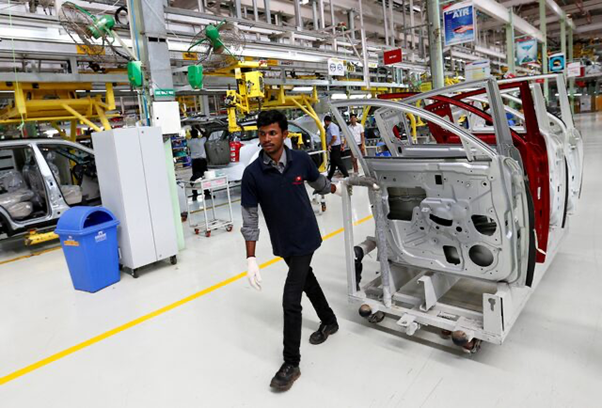 Fig 1: An employee works inside the Mahindra & Mahindra manufacturing plant in Chakan, India, September 30, 2016. REUTERS/Danish Siddiqui/File Photo
Budgetary Allocations for Key Schemes Aiding the Electric Vehicle Ecosystem
In its Budget, the government has proposed an allocation of Rs 2,671.33 crore under the FAME scheme for 2024-25. While the budget estimate was Rs 5,171.97 crore for the 2023-24 fiscal, the revised estimate turned out to be Rs 4,807.40 crore. The government came out with the FAME scheme in 2015 to boost the adoption of electric and hybrid vehicles.
“There was no specific announcement for EVs or FAME 3 in the budget, but that was expected. A couple of days back Mr. H.D. Kumaraswamy, the Minister of Heavy Industries, stated that the announcement regarding this will be made in the near future, but not in the upcoming Union Budget as the preparatory work on FAME 3 is still underway,” said Amit Bhatt, India Managing Director, International Council on Clean Transportation.
He added that the “budgetary allocation for FAME is only to cover remaining liabilities of Fame II, which expired in March and there is no new allocation towards the scheme.”
The scheme’s first phase (with a budget of Rs 895 crore) was in effect from 2015 to 2019, while the second phase (with a budget of Rs 11,500 crore) was from 2019 to March, 2024. Through this, the government provided substantial subsidies to both the OEMs and end-users to make it more affordable solution, and the preferred choice for mobility.
The government later announced the Electric Mobility Promotion Scheme (EMPS) in March 2024 with an outlay of Rs 500 crore for four months. This scheme too is aimed to provide support to the two and three-wheeler segment to fast track the transition.
Although the allocation was lesser this time under the FAME scheme, the government has proposed an allocation of Rs 3,500 crore for the PLI Scheme for Automobiles and Auto Components for 2024-25. This figure is a significant increase, given that in 2023-24, the budget estimate was Rs 604 crore while the Revised Estimates turned up to be Rs 483.77 crore. Reports suggest that this will force auto manufacturers to focus on economies of scale rather than relying on direct subsidies.
For the PLI Scheme for National Programme on Advanced Chemistry Cell (ACC) Battery Storage, the Union Budget 2024-25 has proposed a budgetary allocation of Rs 250 crore. The budget estimate was Rs 1 crore for 2023-24, but was revised to Rs 12 crore for the same year.
 Fig 2: PSUs such as Coal India Limited, NLC India, and NTPC have expressed interest in securing lithium, cobalt, and graphite assets overseas. Reuters
Understanding The Importance of Critical Minerals to Boost EV Adoption in India
During her Budget speech, the Finance Minister said that the government will set up a Critical Mineral Mission for domestic production, recycling of critical minerals, and overseas acquisition of critical mineral assets. “Its mandate will include technology development, skilled workforce, extended producer responsibility framework, and a suitable financing mechanism,” she said.
She said minerals such as lithium, copper, cobalt and rare earth elements are critical for sectors like nuclear energy, renewable energy, space, defence, telecommunications, and high-tech electronics.
“I propose to fully exempt customs duties on 25 critical minerals and reduce BCD on two of them. This will provide a major fillip to the processing and refining of such minerals and help secure their availability for these strategic and important sectors,” she added. So how will this exemption help the EV industry?
Critical minerals like Lithium along with 49 others are used extensively in making the cathodes for most commercial-grade EV batteries. As the world transitions to clean energy sources like e-mobility and renewable energy, the role of critical minerals in global energy security becomes all the more critical. Reducing the dependence on other countries for these minerals and exempting them from duties will make them cheaper, thus helping EV makers drive down prices of these vehicles and increase the momentum of mass adoption.
The International Energy Agency (IEA) predicts that the global demand for lithium will rise 40-fold by 2040 — along with a 20-25 time growth in demand for graphite, cobalt and nickel, given the push for adoption of EVs in various global markets. Therefore, like other governments worldwide, the Indian government too has put these minerals high on its priority list, given the concentration of their reserves in very few geographies on earth.
The “lithium triangle” of Chile, Argentina and the salt flats of Bolivia holds 56% of all known lithium deposits, while 7.9% falls within China. Cobalt is another highly sought-after metal that’s used in EV batteries, and 70% of it is mined by the Democratic Republic of Congo. EV batteries also depend on a combination of several rare earth metals, such as Ruthenium, Chromium and Iridium. However, China at the moment accounts for around 70% of the world’s rare earth minerals supplies, while North Korea is reported to have $10 trillion worth of minerals and two thirds of the world’s rare earths.
India has been consistently upping its game to gain access to these minerals and thwart its dependence on China. India became the only developing country in the coveted Mineral Security Partnership (MSP) – a US-led alliance of 14 developed economies aimed at ensuring uninterrupted supply of critical minerals and rare earth essential for sustained economic growth. This will help the country get these elements needed to not only manufacture EVs, EV batteries but even semiconductors for sensitive electronics.
In this backdrop, the measures on critical minerals announced during the Union Budget have been widely lauded by the EV Industry. “The Union Finance Budget 2024 announced by the Hon'ble Finance Minister lays a comprehensive roadmap towards transforming India into a developed economy...the waiver of import duties on critical minerals, including lithium, is expected to lower battery manufacturing costs, making EVs more affordable,” said Sameer Aggarwal, Founder & CEO, Revfin.
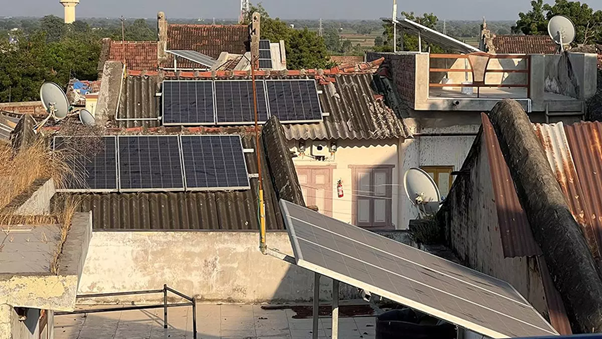 Fig 3: Solar panels on rooftops Photo Credit: Reuters
Why Is Rooftop Solarisation Crucial for the EV Industry
During her budget speech, Sitharaman also stressed that her government will “further encourage” the Prime Minister Surya Ghar Muft Bijli Scheme that aims to install rooftop solar plants for 1 crore households, providing free electricity up to 300 units per month. The initiative announced during the Interim Budget earlier this year has already received a good response with more than 1.28 crore registrations and 14 lakh applications already.
The scheme, which has been allocated Rs 6,250 crore, is expected to reduce reliance on non-renewable energy sources and promote renewable energy adoption. Noting that energy transition is critical in the fight against climate change, the Finance Minister also proposed to expand the list of exempted capital goods for use in the manufacture of solar cells and panels in the country.
So what does this move mean for the EV industry? India has already spelled out its roadmap for strengthening the charging ecosystem in the country to boost EV adoption in its Interim Budget 2024. With EV sales expected to cross the 100 million-mark by 2030, especially with smaller cities driving this push, it becomes crucial to push installation of rooftop solar panels in homes to increase the EV uptake.
Installing rooftop solar panels has its own share of benefits. While people can avail lower per-unit cost of solar electricity, it is also easy to set up in remote areas lacking grid connectivity. Furthermore, many state governments also provide subsidies and incentives for installation of solar panels at homes. According to reports, 40-45% EV users in Rajasthan, Gujarat, and Kerala have deployed solar rooftops to charge vehicles.
“The provisions for solar rooftop installations, enabling one crore households to obtain free electricity up to 300 units per month, mark a significant step towards reducing dependence on conventional energy sources. This initiative aligns with the government's climate change commitments and promotes sustainable growth," said Aggarwal.
 Fig 4: Employees work at the joint manufacturing facility of Renault Nissan Automotive India in an industrial suburb of Chennai, India, this week. AFP/GETTY IMAGES
Recognising the Need for Skilling for Creation of Talent Pool
The budget also announced a new centrally sponsored scheme for Skilling under Prime Minister’s Package for 20 lakh youth over a 5-year period. It also announced the revision of a Model Skill Loan Scheme to facilitate loans up to 7.5 lakh. The Finance Minister also said that financial support for loans up to Rs 10 lakh for higher education in domestic institutions to be provided to youth who have not been eligible for any benefit under government schemes and policies.
At the same time, the Budget also spoke about upgrading 1,000 Industrial Training Institutes in hubs and spoke arrangements. To overcome the key barriers faced by women in the workforce, the Budget also announced a total allocation of more than Rs 3 lakh crore for schemes benefitting women and girls.
“The Union Budget's focus on increasing women's workforce participation and youth skilling is a significant step towards addressing key barriers women face in the workforce, promoting gender equality and economic empowerment. The youth skilling initiative is a forward-thinking move that will enhance workforce skills and employability, driving industry growth and boosting the gig economy, particularly by increasing two-wheeler and three-wheeler sales beyond metropolitan areas,” said Rashi Agarwal, Co-Founder and CBO, Zypp Electric.
Observing that maintaining policy consistency will be essential to the overall expansion of the electric vehicle market, Agarwal hoped that the government will provide clarification and lower or eliminate taxes on last-mile delivery services before the present program expires this month.
Ravi Machani, Co-Founder Investor, Tresa Motors stressed that with the growing demand for expertise in areas like battery technology and power electronics, the budget's focus on upskilling programs and industry-education collaboration is crucial in bridging the skills gap.
“Skilled workers are essential for the EV industry's growth. It's an exciting time with abundant opportunities for those willing to learn new skills. The government's initiative to upskill students over the next five years will ensure a steady supply of talented professionals, driving innovation and sustainability in the EV sector,” he added.
About the Author


