At any given hour, across India’s highways, millions of diesel intercity buses rumble across state borders, carrying nearly 23 crore passengers daily, more than the entire populations of Germany, France, and the United Kingdom combined. Yet, in the urgent conversation about net-zero and clean mobility, these intercity buses barely find a mention.
India’s pathway to net-zero emissions hinges critically on decarbonising its transport sector. While two- and three-wheelers have captured policy attention, urban public transport has become a testing ground for electrification. One of the most impactful yet overlooked segments remains intercity buses. India’s 2.5 million buses account for just 1% of the national vehicle fleet but contribute an outsized 15% of road transport emissions. The majority of these journeys are powered by diesel, locking in high carbon intensity. Approximately 94% of the bus fleet is privately operated, with the remaining 6% managed by state transport undertakings (STUs).
 Credits : Shutterstock, NueGo intercity electric bus
To date, India’s electric bus story has largely been shaped by public transport undertakings on an intracity level. Schemes such as FAME, PM e-Bus Sewa, and PM e-Drive have provided incentives and subsidies, catalysing the deployment of 31,360 e-buses, which is just 1.2% of India’s 2.5 million-strong fleet. While government initiatives have performed well in electrifying bus fleets within Indian cities, 88% of India’s electric bus fleet is deployed outside urban areas on intercity routes that do not fall under any scheme.
The National Electric Bus Programme (NEBP), the first phase of a larger goal to deploy 50,000 e-buses by 2027 to support India’s net-zero target, is on track, but cities struggle with the slow supply of buses. The framework of aggregated procurement and innovative contracting has been globally lauded, but deliveries remain slow due to manufacturing and scaling constraints.
The bigger concern is the imbalance this creates across the market. As state contracts consume most of the available volumes, private operators who dominate intercity transport are effectively sidelined. Manufacturers naturally prioritize large government orders, leaving smaller buyers waiting indefinitely. This has already begun to distort the market. Operators like LeafyBus report painfully slow deliveries, with rollouts stretched over years despite firm orders. Due to these bus supply delays, some entities are now taking the extraordinary step of manufacturing their own buses. Easy Trip Planners, for instance, has launched Easy Green Mobility to build its own e-bus fleet. Rather than a case of entrepreneurial diversification, this highlights gaps in industrial coordination, where the lack of a cohesive supply strategy often compels service providers to take on manufacturing roles to ensure continuity and competitiveness. Rather than a case of entrepreneurial diversification, this highlights gaps in industrial coordination, where the lack of a cohesive supply strategy often compels service providers to take on manufacturing roles to ensure continuity and competitiveness..
 Credits: MSRTC - intercity e bus
Ironically, the technical case for intercity e-buses is strong. The latest ICCT study “ Electrifying India’s buses: Insights from public deployment and case study of private intercity operators” indicates that strategically aligning intercity bus operations with duty cycles, opportunity charging, and optimized battery sizing can significantly enhance the performance and efficiency of electric buses. The study indicates that, under high utilisation, the total cost of ownership (TCO) becomes favourable compared to diesel, with life-cycle savings estimated up to 17% from some journey data collected from existing operators. The economics, therefore, support transition. What hinders adoption is not technology alone but structural barriers in financing, infrastructure, and operational readiness highlighted in the ICCT Study.
Financing remains the foremost constraint. The absence of long-term revenue guarantees and uncertainty around the second life make banks reluctant to extend affordable credit. Small and medium operators, which form 95% of the private sector bus operators, face high interest rates and short loan tenures, which erode the TCO advantage. Without tailored instruments such as credit guarantees, interest subventions, and viability-gap funding, access to capital will remain limited. To unlock private participation, India should institutionalise risk-sharing mechanisms that de-risk investment and allow smaller operators to join the transition.
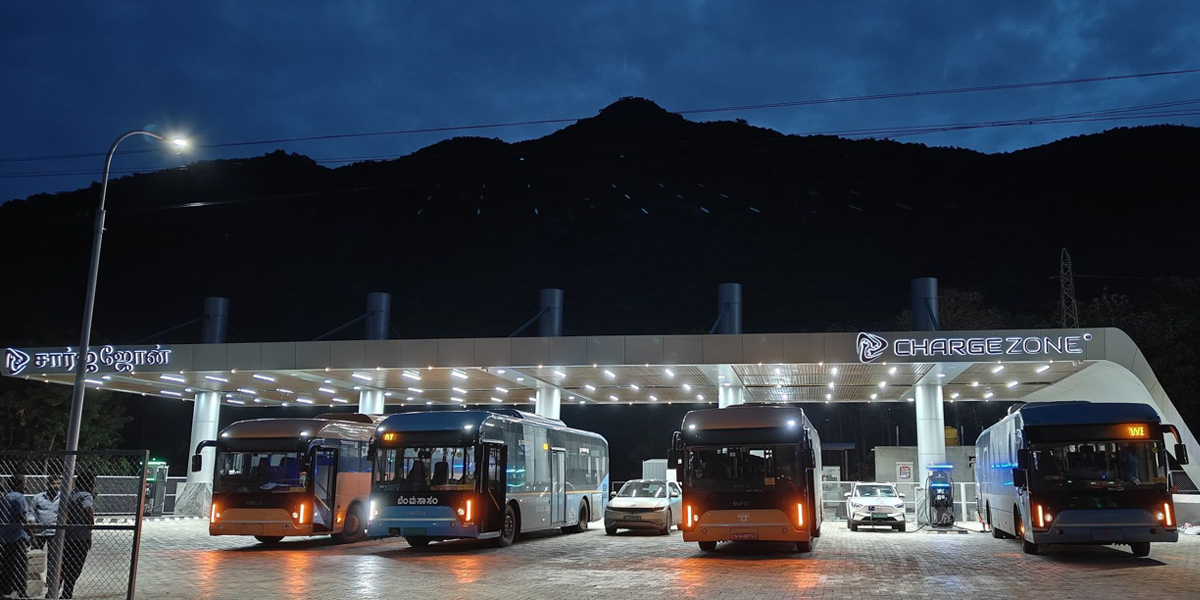
Infrastructure is the second bottleneck. Unlike state undertakings with depot access, private operators rarely own land for charging. Highway charging, however, remains costly, marked by technological inconsistencies and uncertainty around reliable electricity supply needed to support a 240 kW charger suitable for Heavy Duty Vehicles (HDV). Chargers are often unsuited to India’s climatic conditions or lack standardisation, making interoperability a challenge. The PM e-Drive scheme does provide support for 1,800 chargers, but operators often highlight that their main constraint is charging and access to depot spaces within the cities. What is needed is a corridor-based strategy: shared public charging nodes, built along highways and in cities, operating on regulated cost-plus tariffs, and backed by uniform technical standards. Without reliable, heat-resilient charging infrastructure, the intercity segment cannot electrify at scale.
Technology readiness is the third hurdle. Today’s e-buses are largely designed for city duty cycles, frequent stops, shorter ranges, and urban depot-based charging. Intercity operations demand higher durability, robust battery warranties, and service networks capable of roadside assistance. OEMs must innovate on vehicle design for long-haul applications, but policy can also play a role by mandating enforceable after-sales service standards and supporting technical skilling along key transport corridors. Emerging models such as battery-as-a-service (BaaS) and leasing frameworks offer promise by reducing upfront costs, but their viability hinges on interoperability standards and strong regulatory oversight.
Taken together, these challenges highlight the need for a deliberate policy roadmap focused on intercity electrification. Several priorities, as analysed by the ICCT study, stand out.
First, corridor electrification must be operationalised. India has already identified 40 highway corridors for EVPCS (Electric Vehicle Public Charging Stations). Deploying standardised, heat-resilient chargers with predictable pricing rules along these routes would provide operators with the confidence to invest.
Second, risk-sharing finance mechanisms should be developed. Pooled financing platforms with first-loss guarantees, project-based lending that integrates vehicles, charging, and land access, and longer loan tenures would make e-bus adoption financially viable for smaller private players.
Third, battery business models require piloting. Leasing, swapping, and BaaS can shift the cost burden from capital expenditure to operating expenditure. This would allow operators to manage cash flows better while OEMs or service providers retain responsibility for battery performance. Standardised protocols are crucial here to prevent fragmentation.
Finally, land and depot planning must be institutionalised. Municipal and regional mobility plans should earmark land for shared charging depots, lowering the entry barrier for operators who cannot afford land acquisition costs.
Electrifying India’s intercity bus network is not merely a technological upgrade but a necessity. The sector moves millions of people daily and is central to economic connectivity across states. Modernising it by electrification of the intercity fleet can sharply cut emissions from one of the largest contributors to road transport pollution, while simultaneously improving the quality and affordability of long-distance travel. By aligning policy, infrastructure, and finance, India has the opportunity to transform this critical mode of transport into a model of sustainable mobility.
The way forward lies in treating intercity buses as a strategic priority within the broader clean mobility agenda. Coordinated action between government, industry, and financiers can ensure that this vital mode of transport evolves into a backbone of sustainable long-distance travel.
Bhaumik Gowande is an associate researcher at the International Council on Clean Transportation
About the Author


