
India’s electric mobility journey has moved from being just a climate intervention to becoming a robust framework in the mainstream transport sector to drive sustainability
India’s electric mobility journey has come a long way – from being just a climate intervention to getting increasingly recognised as a strong framework for bringing down emissions and urban air quality management and securing the country’s energy needs especially in the present uncertain geopolitical situation. As 2025 draws to a close, electric mobility and clean transport solutions finds itself moving decisively from the sidelines to the mainstream of India’s transport and industrial sector.
India, which aims to achieve 30% EV penetration by 2030, is at a crucial juncture and the government too has recognised the need for it to reduce its dependence on other countries for critical minerals to sustain the momentum of its e-mobility journey. Perhaps that's why, the government through its Union Budget made clear its intent to focus on maintaining policy continuity, recognized the importance of critical minerals – one of the key components used to make batteries that power electric vehicles and help store energy from clean sources – and skilling the workforce to ensure a “steady supply of talented professionals” who can drive innovation and sustainability in the EV sector.
Throughout 2025, electric vehicles became more visible across cities and highways alike, signalling a structural shift in how mobility is planned, financed, and delivered in India. Thanks to enabling policies and its continuity, changing consumer behaviour and challenges faced due to climate change, EVs continued to grow in 2025, led by two-wheelers and three-wheelers, which together form the backbone of India’s transport economy.
While there was also focus on electrification of heavy vehicles, 2025 marked a phase where growth was driven not only by early adopters but by broader consumer segments responding to improving vehicle performance, lower operating costs, and a widening range of models across price points. Strong policy support remained a primary driver of this momentum. Central government schemes, production-linked incentives, and targeted demand-side subsidies continued to shape market confidence, while states competed to attract investments in EV manufacturing, battery assembly, and charging infrastructure.
By the end of 2025, India’s electric mobility transition stood at a clear inflection point, with policy intent, market demand, industrial capacity, and technological capability finding itself at a robust space. However, the hurdle lies in ratcheting up this transition further through equitable means.
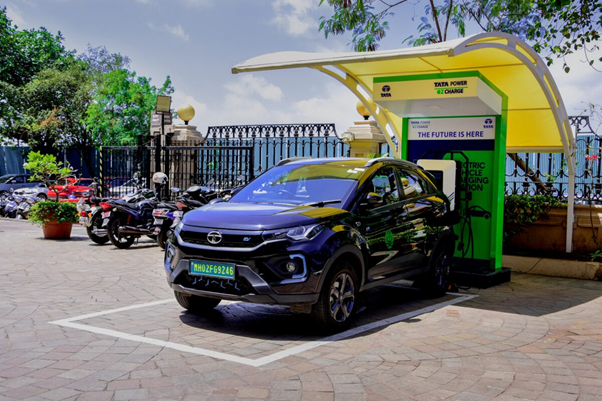 Pic 1: An electric four wheeler at a charging station. Credit: Tata Power
How Did The Electric Vehicle Numbers Stack Up in 2025
Till November this year, 643,288 electric vehicles had been sold in 2025, achieving a significant EV penetration of 7.89%. The two-wheeler electric vehicle section clocked sales figures of 144,855 vehicles in 2025, registering an EV penetration of 6.2% in this segment, according to the EV Dashboard run on Clean Mobility Shift, a platform that draws on data, in real time, from the Government owned Vahan dashboard and presents it in a simplified and user-friendly manner. In the electric three wheeler section, India sold 460,198 vehicles, registering a significant EV percentage of 60.03%.
Similarly in the electric four-wheeler section, 32,959 vehicles were sold across India in 2025 while 1,172 electric buses were added by various states in the country. Uttar Pradesh topped the list of states that achieved maximum EV sales, registering 371,153 vehicles while it also secured the numero uno position among the states that sold the maximum electric three wheeler section. The maximum electric two wheelers were sold in Maharashtra in 2025 while Delhi topped the electric four wheeler sales this year.
This year also marked the start of a new era in the electric four wheeler ecosystem. Top electric vehicle manufacturers like Tesla and Vinfast entered the Indian market while Kia, another international brand, started manufacturing their cars locally in India.
 Fig 2: An electric vehicle (EV) is driven on the road near India's Rashtrapati Bhavan Presidential Palace in New Delhi, India, August 11, 2023. REUTERS/Anushree Fadnavis/File Photo
How Did The Government Shape Up Its Policy Focus on Electric Vehicles in 2025
Apart from providing incentives through its FAME and PLI schemes as well as initiatives like PM-E Drive, the government also made its focus clear on the importance of critical minerals in the present geopolitical context and ongoing tariff wars. In the beginning of the year, it announced full exemption of Basic Custom Duty (BCD) on cobalt powder and waste, scrap of lithium-ion battery, Lead, Zinc and 12 more critical minerals. This comes on the back of the government's announcement of exempting BCD on 25 critical minerals, that were not domestically available, in July 2024.
This came days after the government said that it had approved the launch of the National Critical Mineral Mission (NCMM), a move announced in the Union Budget of 2024-25. The NCMM encompasses all stages of the value chain, including mineral exploration, mining, beneficiation, processing, and recovery from end-of-life products.
In the Budget announced earlier this year, the Indian government had also proposed the addition of 35 additional capital goods for EV battery manufacturing, and 28 additional capital goods for mobile phone battery manufacturing to the list of exempted capital goods. This move, it said, envisages boosting domestic manufacture of lithium-ion batteries, both for mobile phones and electric vehicles.
In June this year, the Government also notified the guidelines for the Scheme to Promote Manufacturing of Electric Passenger Cars in India (SPMEPCI). The Ministry of Heavy Industries had issued the notification on March 15, 2024 while the Ministry of Finance also issued a notification for reduced import duties. According to the scheme, approved applicants must make a minimum investment of ₹4,150 crore in India within a 3- year window.
Under the scheme, applicants can import CBUs of electric 4Ws with a minimum CIF value of USD 35,000 at a reduced customs duty of 15% for 5 years. The maximum number of e-4Ws allowed to be imported at the reduced duty rate is capped at 8,000 units per year, with carryover permitted. The total duty foregone per applicant is limited to the lower of ₹6,484 crore or the committed investment of ₹4,150 crore, it said.
This year also marked the approval of the 'Scheme to Promote Manufacturing of Sintered Rare Earth Permanent Magnets (REPM)’ , a move aimed at establishing 6,000 MTPA of integrated REPM manufacturing in India. The total financial outlay of the scheme is INR 7,280 crore, comprising sales-linked incentives of INR 6,450 crore on REPM sales for 5 years and a capital subsidy of INR 750 crore.
Continuing its focus on building a robust charging infrastructure across the country, the ministry of Heavy Industries (MHI( has issued the operational guidelines this year for the deployment of Public EV Charging Stations under the PM E-DRIVE Scheme. The scheme includes a financial support of INR 2,000 crore for setting up 72,300 EV charging stations across India for different vehicle categories
At the same time, the ministry also issued amendments to the PMP (Phased Manufacturing Plan) requirements for traction motors of e-buses and N2 e-trucks' eligibility under the PM E-DRIVE scheme, effective from September 1, 2025, March 1, 2026, and March 3, 2026. This year, the Ministry of Environment, Forests & Climate Change, Government of India, declared black mass, thats derived while recycling e-wastes, as hazardous waste, restricting its export.
 Fig 3: School students travel in e-rickshaws in Gole Market in New Delhi. Credit: (File Photo) (Hindustan Times)
2025: EV Policies in States
Kerala: The state’s newly notified renewable energy regulations include provisions to support emerging vehicle-to-grid (V2G) technology, allowing electric vehicles to feed power back into the grid.
Uttar Pradesh: The state government announced a capital subsidy of up to ₹10 lakh to support upstream infrastructure costs for public EV charging stations.
Gujarat: The state government cut the motor vehicle tax on electric vehicles from 6% to 1%, effectively providing a 5% rebate. The scheme, which is active on the VAHAN 4.0 portal and will run until March 31 next year, aims to encourage EV adoption, safeguard the environment, and support tourism.
Karnataka: The Karnataka Clean Mobility Policy 2025-2030 became effective from Feb 11, 2025.
Andhra Pradesh: The state recently released the policy document for the state E-mobility Policy (4.0) 2024-29.
About the Author


