
EV sales figures continue to maintain an upward trajectory in China, India and France but is a cause of concern in other nations like Germany, Italy and the US
Electric Vehicles continue to grow in popularity globally in 2024. Although their sales momentum may not be equal across markets, their trajectory continues to rise, varying through segments. Adoption of Electric vehicles are no longer restricted to only wealthy nations now but developing economies like Thailand, India, Turkey, Brazil and others are all experiencing record sales as more low-cost electric models are targeted at local buyers.
According to Electric Vehicle Outlook 2024 by the BloombergNEF, automakers in China continue to push hard towards expanding to newer markers as the country takes a formidable lead in batteries and the EV supply chain. However, India along with Europe and the US have started pushing back against China’s dominance with efforts to onshore manufacturing jobs and support domestic companies.
The report does not paint a very bright picture as far as policy support for EVs is concerned, pointing out towards the slash in subsidies by several European nations while also calling policymakers to not lose sight of the of long-term goals, stressing that “EVs are still the most cost-effective and commercially viable route to fully decarbonizing transport.”
It, however, asserts that despite the complex situation, many next-generation battery technologies are reaching commercialization in the next few years and prices have fallen by 90% over the past decade. “This trend looks set to continue, with early indications that prices are dropping sharply in 2024 due to lower raw-material prices, manufacturing advances, and overcapacity,” it added.
 Fig 1: Research shows electric vehicles are better for the climate and the environment than fossil-fuel driven cars. Seksan Mongkhonkhamsao / Getty Images
Some Key Findings Of The Electric Vehicle Outlook 2024 Report
Three Wheeler Segment: One of the key takeaways highlighted in the report is that only the three-wheeled vehicle segment is on track to achieve a zero-emission fleet by 2050 without additional policy intervention. This is good news for India, which has consistently pushed for adoption of electric three-wheelers through various policy interventions and hand holding measures for the industry.
India’s efforts have been paying off as it recently overtook China to become the biggest market of electric three-wheelers globally, recording a sales figure of over 5,80,000 in 2023, according to the International Energy Agency’s latest Global Electric Vehicle Outlook 2024. It further added that the sale of these three wheelers in India increased by 65% with respect to 2022. One in five three-wheelers sold globally in 2023 was electric, and nearly 60% of those were sold in India.
The BloombergNEF 2024 report said that emerging economies continued to dominate in two- and three-wheeled vehicle sales, with electric sales set to cross 90% globally by “Over 40% of two-wheelers and over 80% of the three-wheelers sold in 2023 were electric, leaving the latter as the only vehicle segment currently on track to achieve a net-zero fleet by 2050,” it added.
Automakers Electrification Targets: While EV sales figures continue to maintain an upward trajectory in China, India and France, it is a cause of concern in other nations like Germany, Italy and the US. Another worry part, according to the report, is the “softening of earlier electrification targets” by several major automakers.
“Tesla, Mercedes-Benz, General Motors and Ford have made cuts to their near-term goals for electric vehicles, often quoting their inability to manufacture EVs at as low a cost as internal-combustion cars,” it said, adding that some others were still moving ahead with their previous targets. Chinese automakers also continue to do well with their EV sales.
Global Passenger EVs: The growth rate of this segment is “visibly slower” than before, the report said. Under its Economic Transition Scenario, EV sales are set to rise from 13.9 million in 2023 to over 30 million in 2027 while “in the next four years, electric car sales grow at an average of 21% per year, compared to the average of 61% between 2020 and The EV share of global new passenger vehicle sales jumps to 33% in 2027, from 17.8% in 2023.”
ICE Vehicles: By 2027, sales of internal combustion vehicles, whose sales peaked in 2017, are set to be 29% below their 2017 peak, it said, adding that ICE vehicle fleet peaks in “Hybrids experienced growing sales in 2023 in specific locations and segments of the passenger-vehicle market. Our economic analysis indicates that electric vehicles will be the primary method of decarbonizing road transport, however, hybrids can play a meaningful role.” it added.
Low Emission Pathways in the commercial vehicle sector: Decarbonisation of vans, trucks and buses has already been initiated and is expected to fast track itself in the coming days. “Sales of electric light-duty delivery vans and trucks are spreading fast in China, South Korea, and several European countries, while sales in the US are weak for now,” the report said.
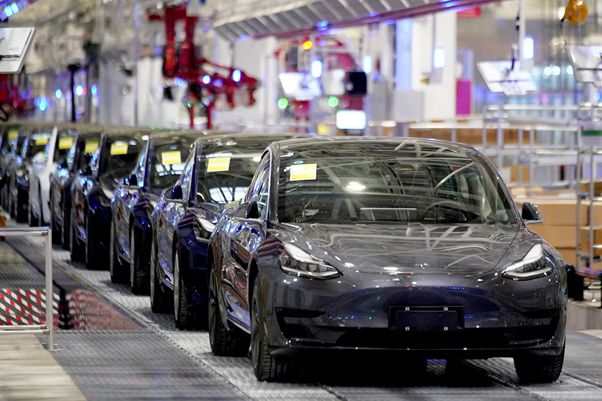 Fig 2: Tesla China-made Model 3 vehicles are seen during a delivery event at its factory in Shanghai, China January 7, 2020. REUTERS/Aly Song/File Photo
Long Term Outlook of Electric Vehicle Growth Worldwide
The report suggests that electric vehicle adoption across the globe will continue its upward momentum in the long term with the BNEF’s Economic Transition Scenario predicting EVs to reach 45% of global passenger-vehicle sales by 2030 and 73% by 2040.
“Despite great progress and a steep growth trajectory, Southeast Asia, India and Brazil are still below the global average adoption by then. A stronger regulatory push is needed in these markets to help bridge the gap with the more developed EV markets,” it said, adding that despite that, by 2040 the three regions represent 15% of the global EV market, up from just 2% in 2023 and 4% in 2030.
“For the world to achieve a completely zero-emission vehicle fleet by 2050, sales of combustion vehicles need to stop around 2038 in our Net Zero Scenario, with leading markets phasing out combustion in the early 2030s,” it added.
About the Author


