
Building on the already-gained momentum and addressing remaining challenges can further accelerate the ZEV transition worldwide
Amid rising concerns over climate change and air pollution, the appetite to switch to clean mobility solutions, especially electric vehicles, has been growing across the globe. Policy enablers brought in by respective governments, cutting-edge innovations, robust battery technology that helps diminish range anxiety among consumers and infrastructure development have provided the much needed fillip to boost EV adoption worldwide.
Despite the rise in interest in these clean vehicles, there is still ample scope to further ratchet up the transition towards zero emission vehicles (ZEVs) to register a significant decline in emission levels that will help the world advance towards the Paris Agreement goals of holding the rise in the global average temperature to well below 2 °C above pre-industrial levels and pursuing efforts to limit the temperature increase to 1.5 °C above pre-industrial levels.
An analysis conducted by the International Council on Clean Transportation (ICCT) has shown that governments across the globe have been putting in place regulations and guidelines that have helped increase ZEV sales shares across markets and further accelerate this transition in 2024. The analysis “updates historical data, revises activity projections and market developments incorporating post-COVID realities, and reviews policy developments between April 2023 and August 2024”, to find that the transition to ZEVs has gained significant momentum.
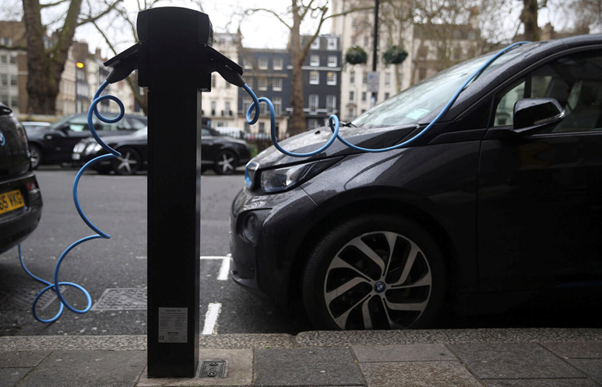 Fig 1: An electric vehicle at a charging station. Pic by Reuters
Zero Emission Vehicle Adoption Worldwide
The analysis highlights that markets and regions are increasingly bringing in ‘supply-side’ vehicle regulations to boost the adoption of ZEVs. “Since April 2023, such regulations have been adopted in six major vehicle markets – Australia, California, Canada, the European Union, the United Kingdom, and the United States,” the analysis – ‘Vision 2050 Update on the global zero-emission vehicle transition in 2024’ pointed out.
The analysis said these standards are increasingly aligned toward achieving 100% ZEV or EV sales for new LDVs by 2035 or shortly thereafter. “For HDVs, recently adopted regulations have paved the way for 100% ZEV sales in California by 2036 and 77% in the European Union by 2040,” it said, adding that sales shares of ZEVs also witnessed an increase across various vehicle segments in quite a number of markets.
“Double-digit increases in ZEV sales shares between 2022 and 2023 were observed for cars in Thailand and Vietnam and for buses in Chile, Canada, and the United Kingdom. ZEV sales shares for medium trucks more than doubled year-over-year in the European Union and the United Kingdom over the same period. These developments show that markets can respond swiftly when favorable conditions align,” it added.
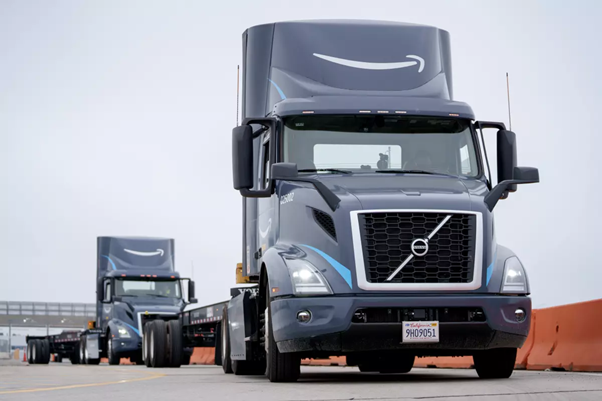 Fig 2: Amazon has begun rolling out big rig electric trucks from ports in Southern California. Pic by Amazon
Global initiatives like the ZEV Declaration and the Global HDV MOU have each garnered new signatories and “now represent roughly one quarter of the global new vehicle market for LDVs and HDVs, respectively”. “The ZEV Declaration gained 3 new signatories since April 2023: Colombia, Costa Rica, and Nigeria. The Global HDV MOU added 11 new signatories, including Colombia, Costa Rica, Ethiopia, Ghana, and Mozambique,” the analysis said.
However, the analysis also highlights certain gaps between the pledges made so far and the trajectory which is aligned to the Paris Agreement goals. “For LDVs, recently adopted policies and commitments have nearly halved this projected ambition gap for 2030. For HDVs and two- and three-wheelers, the ambition gap for 2030 has shrunk by one third and one fifth, respectively. The global projected HDV ZEV sales share for 2030 will need to double to close the ambition gap,” said the analysis which defined the initial ambition gap as the difference between the Baseline 2021 and Ambitious scenarios.
Expanding ZEV Targets To Boost Adoption
Various governments have already put in place policy enablers and guidelines to fast track the transition to ZEVs across the globe. However, a lot more needs to be done to accelerate this progress. The analysis points out that policymakers could consider expanding and strengthening supply-side regulations and ZEV targets, particularly in emerging markets. It also advocates ensuring supply-side regulations include HDVs and two- and three-wheelers in addition to LDVs.
“Moreover, establishing fiscal incentives could increase ZEV adoption by bringing forward the dates of total cost of ownership and purchase price parity. By building on the momentum of recent years and addressing remaining challenges, the global community can accelerate the ZEV transition and make significant strides towards aligning road transport emissions with Paris Agreement goals,” it added.
About the Author


