Scrappage-Linked Incentives, Encouraging Retrofitting ICE vehicles and much more: Delhi’s proposed EV Policy 2.0 reflects alignment of policy ambition and on-ground execution
Delhi has consistently positioned itself at the forefront of India’s electric mobility transition. Back in 2020, Delhi came out with its first EV policy, which took a practical approach towards this transition. By combining strong incentives, clear regulatory direction, and an integrated approach to infrastructure and awareness, the capital succeeded in accelerating EV adoption across segments, particularly in two- and three-wheelers.
The policy not only drove market uptake but also helped shape a broader national conversation around clean mobility and urban air quality, something which the capital has been under strain of for a substantial amount of time. Building on this foundation, Delhi’s EV Policy 2.0 represents the next phase of this transition, one that moves beyond early adoption but towards scale, ecosystem maturity, and long-term sustainability.
The new framework presented by the Delhi government recently in the form of EV policy 2.0 signals a continuation of its proactive approach, aligning mobility transformation with its urgent need to address air pollution and reduce dependence on conventional fuels. It reflects a more systemic, integrated strategy that embeds electrification into the city’s transport planning.
The policy, outlined in the recent Delhi government’s Budget 2026 speech marks a strategic shift from upfront purchase subsidies to a scrappage-linked incentive framework. The framework has been supported by a Rs 200 crore allocation and aims to expedite the retirement of older, high-emission vehicles while reinforcing Delhi’s sustained momentum in advancing electric mobility. Let us take a closer look at what the policy offers.
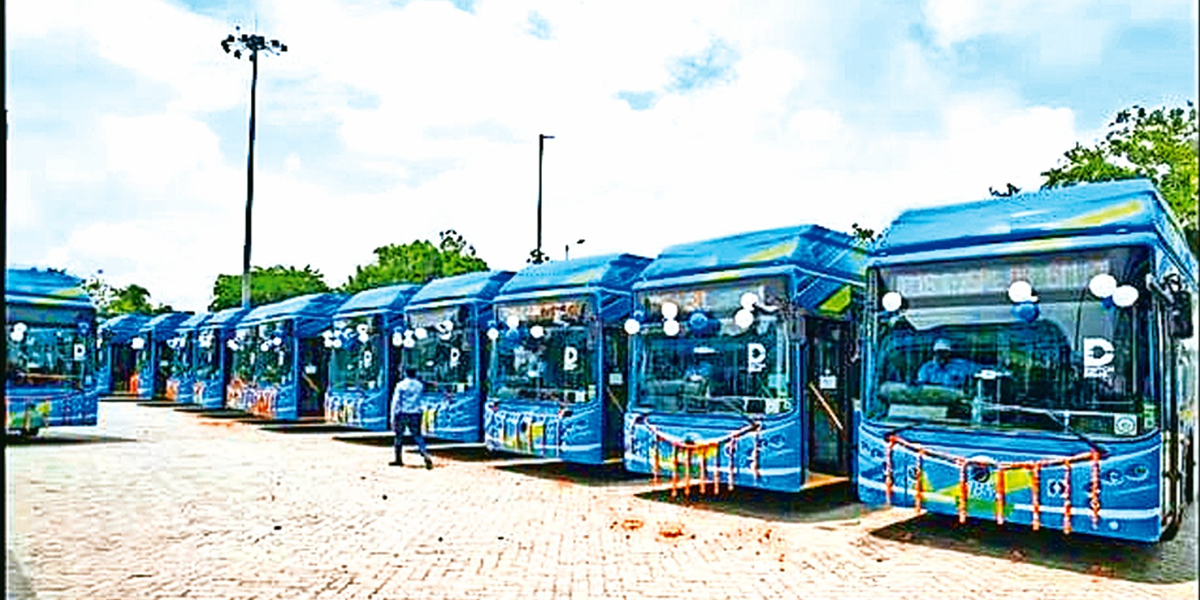
 Fig 1: Electric buses lined up in a Bus yard. Photo Credit: Shashi Shekhar Kashyap
What are the Highlights of Delhi’s proposed EV Policy 2.0
According to reports, to qualify for top-tier incentives under the new policy, buyers will be required to submit a valid scrappage certificate which must confirm the deregistration and scrapping of a Delhi-registered BS-IV or older petrol or diesel vehicle. While for private electric four wheelers, it proposes incentives of up to Rs 1 lakh for vehicles priced below Rs 15 lakh for the first one lakh applicants, for two wheelers, it proposes Rs 10,000 incentives.
Apart from providing incentives, the Delhi government has also encouraged people to retrofit their Internal Combustion Engine (ICE) vehicles through the new policy. According to the proposal, owners converting existing ICE cars into EVs using certified kits can avail a Rs 50,000 grant. The policy now also proposes the introduction of a defined price threshold. Electric vehicles priced up to Rs 30 lakh will remain fully exempt from these charges, while higher-priced models will be subject to applicable standard taxes and registration levies.
The Delhi government also proposes to roll out over 6,000 electric buses in the city by FY2026-27. The charging infrastructure too is slated for rapid expansion. A key measure includes mandating all vehicle dealerships in Delhi to install a minimum of one public charging point. This initiative will contribute significantly to the ambitious goal of establishing 18,000 charging stations across the city by the end of 2026.
To manage the anticipated increase in lithium-ion waste, a new framework for battery recycling has been proposed. The Delhi Pollution Control Committee is designated as the nodal agency responsible for overseeing the "second-life" usage of batteries.
How Has Delhi Faired in EV Adoption So Far
This year itself, Delhi has clocked a sales figure of nearly 13,000 EVs with electric two wheelers contributing the maximum to this. Last year, around 1,13,611 electric vehicles were sold in Delhi across all segments, according to the Cleanmobilityshift Dashboard that draws on data, in real time, from the Indian Government owned Vahan dashboard and presents it in a simplified and user-friendly manner.
Delhi’s continued leadership in electric mobility reflects a rare alignment of policy ambition and on-ground execution. By consistently translating intent into measurable outcomes, the city has set a benchmark for urban clean transport transitions.
About the Author


