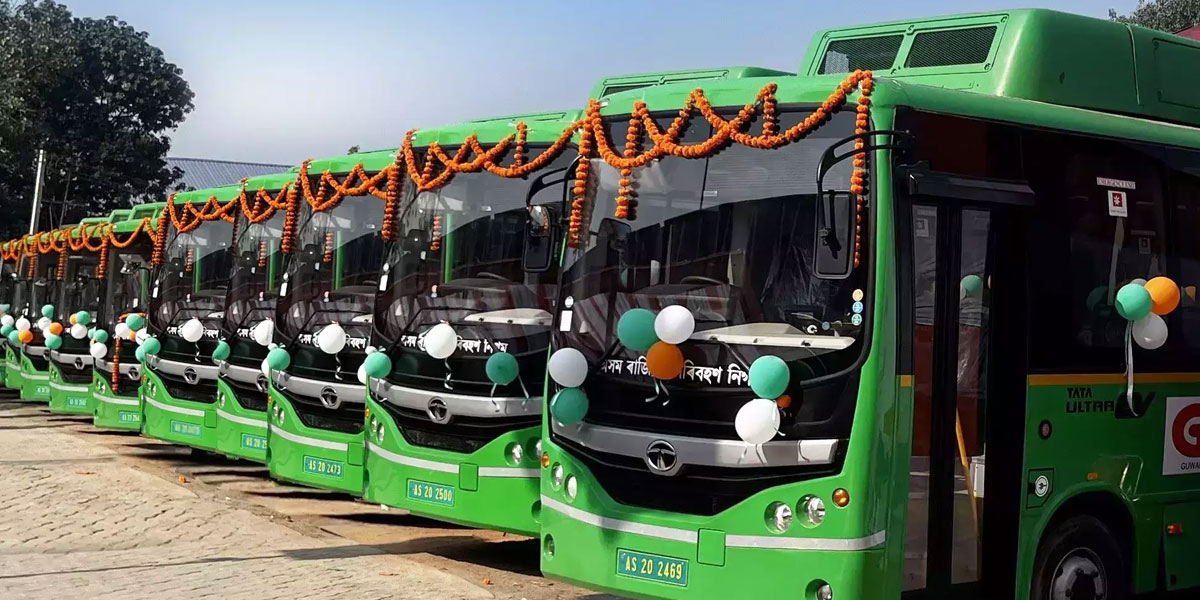
The Assam State Transport Corporation is likely to avoid 537,000 tonnes CO2 of tailpipe emission over the 2023 to 2033 period if it electrifies its bus fleet
Assam launched its Electric Vehicle policy in 2021, aiming to electrify its nearly 1,600 buses plying across nine main divisions and four city services, by 2030. However, the demand for public transport buses is projected to rise significantly in the coming days owing to the increase in urbanisation and population. This presents an opportunity for the Assam Road Transport Corporation, which is mostly dependent on the state government for funding, to scale up its fleet and also transition to electric.
Assam has witnessed significant transformation of its economic ecosystem and fast tracking it further will be heavily dependent on a robust road transport sector. According to a study, the state will need a 2,450-strong bus fleet by 2033 to cater to its growing demand. Given that its population is spread across urban as well as rural landscapes, it is crucial to put in place a very accessible public transport system, especially buses, for people to commute and contribute to this burgeoning economic ecosystem.
It is, however, no secret that buses plying on fossil fuels like diesel, contribute heavily to pollution. “If ASTC continues using its existing fleet and adds more diesel buses to cater to growing demand, the emissions from ASTC’s fleet are projected to increase from 70,250 ton CO2 in 2023 to 115,000 ton CO2 by 2033, i.e., 63.7% increase,” the study projects.
On the other hand, if the corporation undergoes the transition to electric, the transformed e-bus fleet is projected to avoid 537,000 ton CO2 of tailpipe emission over the 2023 to 2033 period. Moreover, there are financial benefits attached to this transformation owing to the low cost of ownership of e-buses, providing ASTC – Rs 73.1/km compared to Rs 80.5/km for the long route buses and Rs 69.4/km vs Rs 78.6/km for city operations.
However, this transition will also require investment, with estimates putting it at Rs 6,150 crores between 2023 and 2033, in which 46% will need to be directed towards procuring assets like buses, batteries, and charging stations, 9% for electricity purchases, 18% towards operations and maintenance, and the rest 27% for manpower.
 Fig 1: Electric Bus charging station. Image Credit: petovarga/Shutterstock.com
What Are The Benefits Of Transitioning The Assam Bus Fleet To Electric
- Environmental implications: The adverse effects of climate change are pushing governments to act against curbing emissions. Conventional vehicles plying on fossil fuels contribute heavily to greenhouse gases. Converting the bus fleet of Assam to electric will help in curtailing tailpipe emissions. Charging these vehicles through solar powered chargers will further reduce the emission burden.
- Savings in the long run: The operational cost of electric vehicles in the long run is substantially low, despite significant initial investments. Electric buses have low maintenance cost compared to conventional vehicles.
- Access to Financial help: The ASTC is mostly funded by the state government. Given that the corporation embarks on the path to transition of its bus fleets, it will make it eligible to get grants or financial help from central government schemes, thus improving its financial health.
- Fuel price volatility: Diesel or petrol prices remain volatile and tend to fluctuate from time to time. ASTC’s decision to electrify its bus fleet will protect it from unpredictable energy costs. Once these costs remain stable, it will help the corporation to optimise budget allocation, realise long term savings and remain sustainable.
- Improved Technology: Despite being a new technology, there have been advancements in e-bus technology off late that includes enhanced batteries which provide long range and fast charging. Embracing this transformation can help ASTC provide commuters with sustainable transport solutions.
- Skilling and job opportunities: The transformation will also foster economic development by providing job opportunities in the local manufacturing and supply chains. Being a specialised sector, maintenance and operation of these e-buses will also require specialised skills, thus enhancing job opportunities further.
The Future Roadmap for Bus Electrification in Assam
As a state which has fast tracked economic development, it is essential for Assam to embark on a clear roadmap of sustainable and environment-friendly transportation. The Assam State Transport Corporation can take significant strides by transitioning its bus fleet into electric by optimising its operational plans and undertaking certain activities to ensure a greener future.
The corporation can start by exploring ways to find a balance between its financial stability, government funding and inviting private players for this transition. While it can explore ways to reduce government support by preparing a conducive atmosphere for private investments, it can simultaneously deliberate on ways to increase modal share of public transportation.
To overcome range anxiety, it can “undertake geospatial planning exercises to identify optimal charging infrastructure locations depending on current and prospective routes, depots, and charging strategies.” as well as conduct “grid impact studies for charging station deployment”.
It also makes a great case for the ASTC to “create a framework to calculate its carbon footprint” to better understand the environmental benefits of transition to the e-bus fleet.
About the Author


