
Continued support through FAME subsidy, increased allocation for PLIs, greater adoption of e-buses through payment security mechanism and focus on expanding charging infrastructure poised to give fillip to higher EV adoption
Further strengthening its commitment towards fostering a cleaner and sustainable future, the Interim Budget 2024-25 presented by Finance Minister Nirmala Sitharaman laid out the government's commitment to bolster India’s Electric Vehicle ecosystem, which stands at the verge of an impressive expansion.
Realising that adequate charging infrastructure and transitioning of public transportation, especially buses, as the key towards sustainable mobility, the government spelled out its focus on these strategic initiatives, aiming to fortify and broaden the EV landscape. While many in the industry were expecting big ticket announcements, the government stopped short of specifying any policy initiative but made its intention clear about pursuing green growth.
Considered one of the key barriers in faster adoption of EVs, the focus on installing more charging stations, announced in the budget, is expected to go a long way in increasing the acceptance of EVs among consumers, attract investor interest, generate employment and put to rest the ‘range anxiety’ dilemma which prevents many from adopting these vehicles.
Another crucial announcement was the promotion of e-buses through payment security mechanisms, which many have said will prove to be a ‘game changer’.
While the government has given an exponential budgetary boost to the overall automotive sector by increasing its allocation, it also realised that importance of hand-holding the EV industry by increasing the allocation of two Production Linked Incentive (PLI) schemes – Automobiles and Auto Components and National Programme on Advanced Chemistry Cell (ACC) Battery Storage to boost production of futuristic technologies in this sector.
There were, however, no announcements on the EV industry’s long pending demand of reduction of Goods and Services Tax (GST) on Lithium-ion batteries, which they argued would have brought down the overall cost of acquiring EVs. Others felt that the budget also remained short of talking about the integration of EV infrastructure into Priority Sector Lending (PSL) that could have bolstered credit flow into the sector by mandating financial institutions to provide support.
Interim Budget: Key takeaways for EV Sector
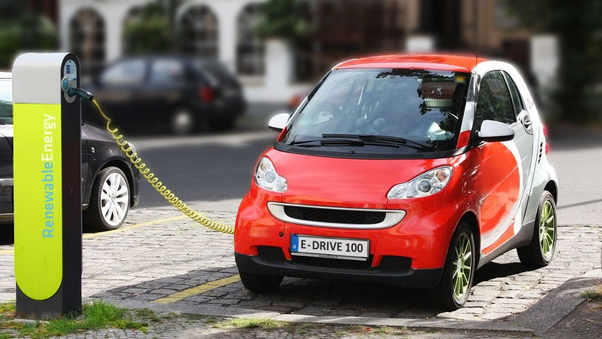 Fig 1. Electric car at a charging station | Wikimedia commons
FAME subsidy/PLI Initiatives
To boost sustainable green mobility, the government announced an exponential increase in its allocation to the overall automotive sector. It has set aside Rs 6671.33
Crore for the auto industry but much to the dismay of the EV industry, especially the two-wheeler segment, cut down on the outlay of FAME subsidy by over 40%. For 2024-25, the government has set aside Rs 2671 crore, in comparison to revised estimates of Rs 4807.40 in 2023-24.
The scheme was launched in 2015 to promote electric and hybrid vehicles and its second phase ends in March this year. The reduction comes following a cut in the subsidy for e-two wheelers last year when the government slashed the incentive from Rs 15,000 per kWh of battery to Rs10,000 per kWh, affecting sales in this segment for some time.
"The interim budget might not have specified any policy or allocation towards the EV sector. However, it did mention the intention to promote EV in public transportation. Additionally, what we need is to strengthen the EV ecosystem holistically for which budget is indicated towards policies and measures that will be undertaken to support manufacturing and charging infrastructure. Clearly, EV stands in the priority list of the government and we can expect the upcoming FAME policy and August session to encompass all the particulars,” said Chakravarthi C, spokesperson, Quantum Energy, a leading EV 2 Wheeler Manufacturer."
The government, however, gave a huge boost to the EV industry by increasing the allocations in various PLI schemes. It has set aside Rs 3500 crores for the PLI Scheme for automobiles and auto components, up from the revised estimates of Rs 483.77 during last fiscal. Similarly for the PLI Scheme for National Programme on Advanced Chemistry Cell (ACC) Battery Storage, it has allocated Rs 250 crore, up from the revised estimates of mere Rs 12 crore in 2023-24.
This will surely provide some relief to the industry as the initiative has come across major challenges. While the government had been working towards standard operating procedures for claiming incentives, there were almost no disbursals in the first year of the initiative. There were zero disbursals in the first year of the scheme and even in 2023-24, the actual disbursements are lower than the ₹604 crore budgeted at the start of the financial year in March last year, reports suggested.
Through FAME II, the Ministry of Heavy Industries (MHI) had provided Rs 5,228 crore in subsidies for approximately 1.15 million EVs sold till December 1, 2023. While many in the industry were expecting the announcement of the FAME III subsidy, the government stopped short of doing that in the budget. “We look forward to the July budget where the focus will be on the FAME II scheme and much-anticipated FAME III scheme,” said Pratik Kamdar, CEO & Co-Founder, Neuron Energy.
Recently in its 2023 year-end review, the MHI said the proposal for the enhancement of the outlay of the FAME II scheme from Rs 10,000 crore to Rs 11,500 crore has been examined by the Department of Expenditure (DoE) and approved considering its objectives.
Rohan Shravan, Founder and CEO of Tresa Motors said extending FAME-II subsidies beyond two-wheelers to include commercial EVs would significantly accelerate their adoption, promoting cleaner logistics and reducing carbon footprint.
 Fig 2. India’s largest electric vehicle charging station in Gurugram | Twitter | @amitabhk87
Charging Infrastructure
“Our Government will expand and strengthen the e-vehicle ecosystem by supporting manufacturing and charging infrastructure,” Sitharaman said during her speech. This was perhaps one of the most important announcements made in the Interim Budget. Here’s why.
India recorded unprecedented EV growth numbers last year, crossing the 1 million mark sales for the second year in a trot. Nearly 1.4 million electric vehicles were sold across the country in 2023, compared to 1.02 million the year before, registering a jump of 6.34 %. But one of the critical challenges towards even better adoption is the lack of adequate charging infrastructure.
According to a Confederation of Indian Industry report, India will require a minimum of 1.32 million charging stations by 2030 to facilitate the rapid adoption of EVs. To ensure an ideal ratio of 1 charger for every 40 electric vehicles, India will need to install over 4,00,000 charging stations annually, with a cumulative total of 1.32 million chargers by the targeted year, it predicted. Given this scenario, it is imperative that India ramp up this infrastructure.
“The government's announcement in the Union Budget speech regarding the expansion and strengthening of the e-vehicle ecosystem by supporting manufacturing and charging infrastructure is both welcome and much needed. Charging infrastructure remains a major barrier for EV adoption in India and this announcement directly addresses that,” says Amit Bhatt, India Managing Director, ICCT.
Some believe that growth in the EV charging infrastructure will also generate employment opportunities for the youth as companies will be on the lookout for people with technical know-how of running and maintaining charging stations.
“We believe that as the govt rolls out details of the scheme in the coming days for growing the EV public charging infrastructure, the availability of public chargers across the country will significantly grow and EV companies like ours will find higher market acceptance from its consumers and also attract investor interest. This will also break the ‘range anxiety’ , the biggest barrier for EV adoption in our country,” Dinesh Arjun, Co-founder and CEO, Raptee Energy.
He argued that while this will also help EV companies to enjoy a deeper vendor ecosystem providing battery and other components for building make in India EV vehicles, the support in providing financial assistance and support to EV manufacturing will encourage entrepreneurs to do deeper innovation in the battery management segment and other technologies.
Akash Gupta, Co-Founder and CEO, Zypp Electric pointed out that the budget not only encourages entrepreneurship but also opens doors for a multitude of vendors, providing ample opportunities for supply and installation services. “The focus on creating employment opportunities for the youth, particularly those with technical skills in manufacturing, installation, and maintenance, will catalyse innovation and growth,” he said.
 Fig 3: Electric buses. Credit: Ashok Leyland
Greater adoption of e-buses
The government also made its intentions of pursuing a sustainable greener future by encouraging the widespread adoption of electric buses, which it said, will be facilitated through the implementation of a payment security mechanism to foster confidence among e-bus operators. It said the initiative aims to invigorate the public transport network, promoting an eco-friendly and energy-efficient mode of commuting.
The announcement could not have been more timely. The government last year approved a scheme that envisages the deployment of 10,000 electric buses – along with charging and associated infrastructure – in nearly 170 cities. Named ‘PM-eBus Sewa', it is set to cost over Rs 57,000 crore and will also “foster innovation” in the e-mobility sector. The government eventually aims to introduce 50,000 electric buses nationwide to curb harmful emissions in the transport sector.
There are around 12,000 e-buses across the country at present. “Timely payment stands out as a significant obstacle hindering private sector participation in the bus operations sector in India. With the government's push to increase private sector involvement in the e-bus rollout, the inclusion of a payment security mechanism can be a game-changer for scaling up e-bus operations,” said Bhatt. The initiative comes after some bus manufacturers raised concerns over delayed payments by state transport corporations for their previous orders owing to their poor financial health.
The encouragement of greater adoption of e-buses for public transport networks through payment security mechanisms is a notable benefit, feels Kamdar. These investments not only pave the way for increased EV sales and adoption but also open doors for burgeoning job opportunities and entrepreneurial ventures within the sector, he said.
“The encouragement for greater adoption of e-buses in public transport networks, coupled with the implementation of payment security mechanisms, not only propels environmental sustainability but also sparks innovation and economic prosperity,” said Benjamin Lin, President, Delta Electronics India.
 Fig 4. Solar charging station. Pic Credit Getty
Corpus to boost private investment in sunrise technologies
The government also announced that it would create a corpus of Rs 1 Lakh crore to boost private investment in sunrise technologies, a term used for something which is growing fast and is expected to witness a rapid boom in the future. The corpus will be established with a fifty-year interest free loan and provide long-term financing or refinancing with long tenors and low or nil interest rates.
Through this, the government aims to encourage the private sector to scale up research and innovation significantly in sunrise domains. Experts said the new age technologies and data are changing the lives of people and businesses. “They are also enabling new economic opportunities as India is showing solutions through innovation and entrepreneurship," says Hari Kiran, Co-Founder and COO, eBikeGo.
Hyder Khan, CEO of Godawari Electric Motors said the focus on creating accessible and eco-conscious mobility solutions underscores the significance of this announcement in the budget. “These efforts will enhance EV adoption, paving the way for a cleaner, more interconnected future. The details of this announcement in the forthcoming budget will play a crucial role in steering the country's net-zero agenda in a positive direction,” he said.
Automotive Skill Development Council vice president Vinkesh Gulati said the budget laid out a comprehensive strategic direction, encompassing enhancement of
manufacturing base, fortifying charging infrastructural backbone for EVs and avid
incorporation within public transportation.”Concurrent advances in such technology bound sectors will necessitate extensive skill upgradation -an aspect energetically endorsed zealously pursued across nations appreciating ceaseless evolution technological advancements whose far-reaching potential impacts holistic inclusive societal betterment,” he said.
Rooftop solarisation
The government also laid out its plans for rooftop solarization through which it plans to provide 300 units free electricity every month to one crore households. It aims to save Rs 15,000-Rs 18,000 for households annually and sell the surplus to distribution companies as well as help in charging Electric Vehicles. This will also enable Entrepreneurship opportunities to a large number of vendors for supply and installation and employment opportunities to the youth with technical skills in manufacturing, installation and maintenance.
“We're also encouraged by the vision for rooftop solarisation and free electricity, empowering consumers and contributing to energy security. The installation of 1.3 crore LED street lights further demonstrates the government's commitment to sustainable infrastructure and improved road safety. While these initiatives are impactful, we believe the budget could have further fuelled India's economic engine by considering additional measures. Targeted incentives for local battery production and recycling facilities would bolster supply chain resilience and create valuable jobs,” said Shravan added.
Others believe that collaboration with the government and stakeholders is pivotal to the initiative's triumph, nurturing renewable energy adoption and combating energy poverty in India. “Our enthusiasm is boundless as we strive to empower communities, advance sustainable practices, and forge a greener, more equitable future for all," said VG Anil, CEO, ARENQ.
EV Financing
Many in the industry had hoped that the government would announce key initiatives in the budget that will help overcome one of the biggest barriers to high EV adoption in India – access to low-cost finance. They believed that since the higher cost of these vehicles deter consumers, the promise of life tax subsidies for electric vehicles and the availability of accessible EV financing options are key to mitigate this challenge. However, there were no announcements in this regard in the Interim Budget.
Many are of the opinion that integration of EV infrastructure into Priority Sector Lending (PSL) will bolster credit flow into the sector by mandating financial institutions to provide support. According to a report by NITI Aayog and Rocky Mountain Institute (RMI), India’s weighted-average EV sales penetration has the potential to be about 70% by 2030. To achieve this, over the next decade, India would need a cumulative capital cost of INR 19.7 lakh crore (USD 266 billion) across vehicles, supply equipment and batteries. The estimated size of the annual EV finance market will be INR 3.7 lakh crore (USD 50 billion) in 2030, the report said.
Sameer Aggarwal, CEO and Founder of Revfin Services, the country's leading electric vehicles segment focused financing company said the commitment to fortify the EV ecosystem and support manufacturing and charging infrastructure aligns with global environmental goals, positioning India as a leader in widespread sustainable mobility adoption. “Continued focus on the rural economy support, youth skill development, and gender-inclusive initiatives reflects a holistic approach toward inclusive and sustainable growth. Skill India Mission's success in training 1.4 crore youth strengthens the workforce for evolving job demands," he said.
 Fig 5: An e-car battery. Pic Credit Tesla
Reduction of GST on Li-ion batteries
Built-up EVs are subject to a 5% Goods and Services Tax (GST) but lithium-ion batteries as well as charging stations are charged 18% GST. The EV industry had hoped for a reduction of the GST on Li-ion batteries to 5 %, which would have provided them with the much needed relief. But there were no clear cut announcements by the government in this segment. Others still remain hopeful that the government will come out with some reform when the actual budget is presented in July as such a revision has the potential of substantially alleviating manufacturing costs, enabling manufacturers to offer EVs at more competitive prices and further encourage consumer adoption.
Although the government refrained from announcing any major policy initiatives, its focus and intentions to bolster the EV ecosystem has been welcomed by most in the industry. The initiatives announced, experts feel, not only accelerates the transition to sustainable transportation but also fosters innovation and job creation within the EV sector.
“The announcement of a new scheme for bio-manufacturing underscores the government's dedication to promoting green growth and environmental stewardship. At Snap E Cabs, we embrace these advancements wholeheartedly and stand ready to play our part in driving the adoption of electric vehicles, advancing eco-friendly mobility solutions, and building a greener future for generations to come,” said Mayank Bindal, Founder and CEO, Snap E Cabs.
Brajendra Singh Tomar, Co-founder & CEO, Finayo said the government's attention on EVs and investment in charging infrastructure demonstrates its commitment to promoting their wider adoption. “Collaboration among governments, car manufacturers, and charging station providers is regarded as critical for building a fully operational and sustainable electric vehicle culture,” he said.
About the Author


