The Clean Mobility Policy 2025-30 aims to position the state as a premier destination for manufacturing, attain net-zero goals and build a sustainable mobility ecosystem
Karnataka has emerged as a frontrunner in India's electric vehicle (EV) revolution, setting benchmarks in policy innovation, adoption rates, and manufacturing capabilities. It was one of the first states to announce a forward-looking EV policy and since then, has been taking the lead in establishing a sustainable clean mobility ecosystem in the state. No wonder, the state achieved significant numbers in terms of EV adoption, clocking EV sales of 1.25 Lakh in 2024, according to the Clean Mobility Shift Dashboard.
Karnataka has around 2.5 Lakh registered EVs, ranking it third in the country. While the state boasts of having 5,403 installed EV charging stations, its budget 2024-25 has announced 2,500 EVCS under PPP mode and 100 charging stations through ESCOMs fund at a cost of Rs 35 crore. The state has now set its sight on further ratcheting up its clean mobility ecosystem. It has come up with a Clean Mobility Policy (CMP) 2025-30 which is a step further towards achieving net-zero emissions and establishing Karnataka as a key manufacturing hub for zero emission vehicles.
Experts believe that with this policy support, the state can become a centre of clean technology innovation and play a crucial role in realising India’s transition to ZEVs. The new policy offers support across the ZEV value chain, from battery and cell manufacturing and recycling to charging infrastructure, hydrogen refuelling stations, among others, according to an article that appeared in the International Council on Clean Transportation (ICCT). So let us take a closer look at the policy and assess how it may have a potential to position the state as a premier destination for a clean vehicle manufacturing.
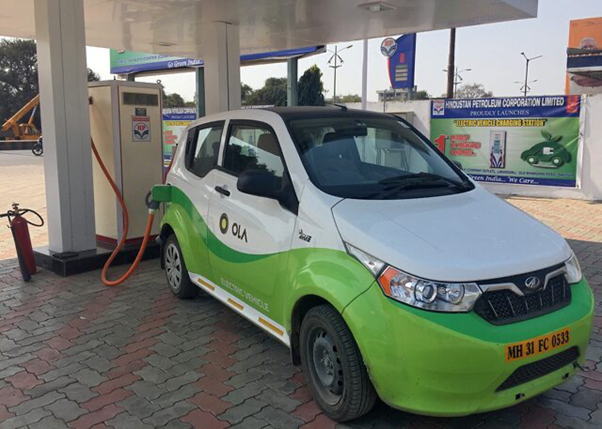 Fig 1:Mahindra's e2oPlus, operated by Indian ride-hailing company Ola, is seen at an electric vehicle charging station in Nagpur, India January 24, 2018. Picture taken January 24, 2018. REUTERS/Aditi Shah
Breaking Down The Objectives of Karnataka’s Clean Mobility Policy 2025-30
One of the first objectives of the policy is to attract investments of Rs 50,000 Crore across the entire Clean mobility vehicle value chain, generating approximately 100,000 new jobs during the policy period, and establishing a comprehensive and supportive clean mobility vehicle ecosystem in the state. The state plans to position Karnataka at the top in Asia in terms of future clean mobility and intends to do so by developing sizable clusters to attract manufacturing units and give initial incentives to stimulate interest from players across the complete clean mobility vehicle value chain, says the policy document.
The policy also aims to accelerate clean vehicle adoption through a robust charging infrastructure network or hydrogen stations. It intends to do this by fast tracking identification of strategically located land parcels aligned with power infrastructure and also leverage OMCs (Oil Marketing Companies) for rapid development of stations. The policy also envisages offering favorable power tariffs to these charging stations.
The policy also envisages encouraging establishment of common facilities and testing infrastructure within the clusters as well as fostering collaborative linkages between industry, academia, and start ups to create clean mobility specific curriculum. The state also plans to promote research and development, spurring innovations in future mobility and encouraging the recycling industry to foster a circular economy.
The policy also aims to foster collaboration with international institutions to expand EV-focused training programs in ITIs, polytechnics, and universities to build a specialised workforce for the clean mobility industry. Through policy support, the state also plans to introduce capital subsidies for developing fast-charging stations, battery-swapping networks, and hydrogen fuelling stations to ensure a statewide reliable clean energy network.
Moving Ahead: What Experts Have To Say
Some experts are of the opinion that dispensations across regions have supplemented such initiatives with supply side regulations like sales mandates to ramp up ZEV adoption. Quoting an earlier research on the advantages of ZEV sales regulation, an ICCT article said this could “increase the number of ZEV model choices available, as manufacturers would increase their offerings to attract consumers.”
“A ZEV sales regulation would increase industry-wide manufacturing and lead to economies of scale that would ultimately bring down the purchase price of ZEVs. This would also be likely to expedite the achievement of cost parity with internal combustion engine vehicles,” the ICCT article argued.
About the Author


