Road transport moves 71% of India’s freight, with trucks forming the backbone of this network, these medium and heavy-duty trucks (MHDTs) account for less than 3% of vehicles on the road while producing ~35% of on-road fuel consumption, ~45% of total on road transport sector emissions. Alarmingly, these MHDTs also account for 53% of particulate matter (PM) emissions from the road transport sector, making them one of the major contributors to India’s deteriorating air quality. With growing economic activity, the number of MHDTs is projected to increase nearly fourfold by 2050, posing significant challenges for energy use, emissions, and public health. This underscores the urgent need to decarbonize road freight transport, where the adoption of Zero-Emission Trucks (ZETs) offers a critical opportunity to drive this transition.
In India, both national and state governments have introduced various initiatives to accelerate Zero-Emission Truck (ZET) adoption, including tax exemptions, awareness campaigns, and pilot programs. However, despite these efforts, ZET penetration in FY 2024–25 stood at only 0.06%. Recently, the government announced upfront subsidies for ZET purchases, bringing this segment under the PM E-Drive scheme. Yet, significant barriers persist such as high upfront costs (2 to 3 times higher than ICE counterparts), limited model availability, nascent technology, uncertain resale value, lack of financing options, and inadequate charging infrastructure, hindering large-scale adoption.
Collaborative Frameworks to Scale ZET Deployment
Policy interventions have helped bring down upfront costs and improve the total cost of ownership, encouraging OEMs to expand their ZET portfolios. However, financing continues to be a major bottleneck—driven by uncertain salvage values, high product and operational risks, and elevated interest rates. In India’s highly fragmented trucking sector, where 98% of diesel truck purchases are financed through NBFCs, banks, and other lenders. The absence of tailored financing instruments for electric trucks has forced buyers to rely on private equity or debt funding for outright purchases. Here the innovative financing coupled with risk-sharing facilities can bridge this gap. Incorporating de-risking tools into financing structures can instil greater confidence among stakeholders, enable financiers to better underwrite risks, and create the trust needed for sustainable and scalable business models. In particular, a well-designed Risk Sharing Facility (RSF) can serve as a catalytic tool—unlocking capital, offering loan guarantees, enabling blended finance models, fostering service-level contracts, and boosting lender confidence by absorbing a share of potential losses.
Globally, diverse financing models support the ZET transition—offering valuable lessons for shaping RSF framework domestically.
Adapting from Global Playbooks for India’s ZET Push
California’s approach to ZET financing illustrates how structured support could enhance accessibility and affordability for ZETs. The California Air Resources Board (CARB), in collaboration with the California Pollution Control Financing Authority (CPCFA), leveraged the California Capital Access Program (CalCAP) program to operate through a loan-loss reserve pilot program for certain truck fleets.
Under this model, a dedicated reserve account was created for each participating lender. For every loan sanctioned, CARB contributed 25% of the loan amount into the lender’s reserve account. In the event of a default, the lender could request reimbursement of the principal loss from CPCFA. This mechanism allowed lenders to cover up to 100% of loan losses during the enrolment period, provided sufficient funds remained in the account. If no defaults occurred, the contributions stayed in the lender’s reserve account, further strengthening their risk buffer.
A similar approach could be adopted in India’s RSF design for ZET adoption by incorporating a loan-loss reserve fund to mitigate financing risks and encourage lending. This also highlights the potential for active participation from subnational governments in India, enabling them to co-design the RSF and contribute meaningfully to the zero-emission freight transition.
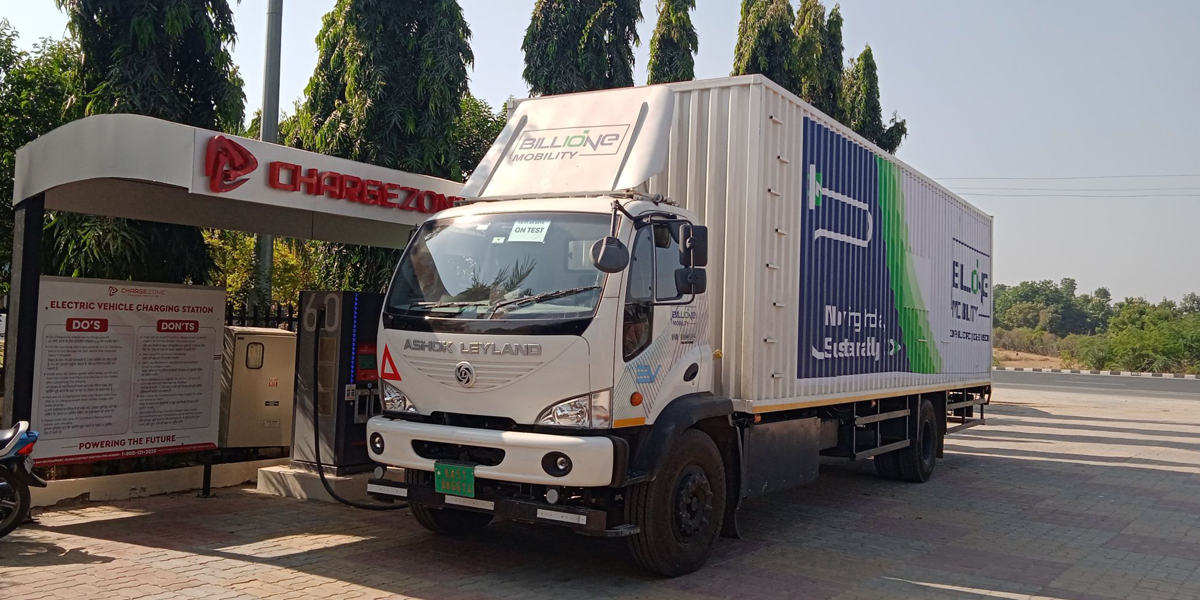
 image credits : e-truck charging at a charging station powered by BILLIONe and Charge Zone
Strategic Blueprint for ZET Financing and Risk Mitigation
To accelerate ZET adoption, the risk mitigation framework could be developed as a multi-stakeholder mechanism that addresses lifecycle risks, high interest rates, product failure, uncertain salvage values, limited charging infrastructure, and inconsistent shipper demand, while clearly assigning responsibilities across stakeholders. Below section delves deeper into the proposed framework:
Financial and Institutional Architecture
The proposed framework is anchored by a program manager, which could be a mission driven Development Financial Institution. To manage risks, necessitate mobilising the blended finance, supported by funding from philanthropic institutions and development banks to the program manager. The program manager could establish and maintain a Loan Guarantee Reserve Fund (LGRF), a dedicated corpus to ensure long-term financial stability and provide a safety net for the RSF in the event of financing defaults. A portion of funding received from the philanthropic institution is transferred to the LGRF, while the remaining portion is used to provide loans to the ZETs.
The Program Manager provides financial support to LSPs/ eMSPs by offering loans and empanels OEMs based on the relevant use cases and model availability. To ensure the financial framework delivers intended outcomes, seamless collaboration among stakeholders through well-defined agreements would be essential.
Risk Management & Stakeholder Responsibilities
Effective risk management requires clearly defined roles and responsibilities across all stakeholders. Establishing accountability ensures that risks are systematically addressed throughout the ZET financing and deployment lifecycle. The roll out of Service Level Agreements (SLAs) among key stakeholders, including Original Equipment Manufacturers (OEMs), Logistics Service Providers (LSPs), e-Mobility Service Providers (e-MSPs), Charge Point Operators (CPOs) and Shippers with clear defined tenure and dispute resolution templates, is critical.
Under PM E-DRIVE scheme, electric trucks are required to have a minimum warranty of 5 years or 2.5 lakh km for the motor and vehicle, and 5 years or 5 lakh km for the battery, whichever is earlier. Building on this, OEMs could design Annual Maintenance Contracts (AMCs) with LSPs to boost customer confidence, reduce product level risks and ensure regular asset upkeep. As the shippers drive the freight demand, ensuring the operational viability of ZETs requires LSPs to establish long term SLAs with them. The SLA with shipper can guarantee a minimum number of trips and payload per month, ensure predictable cash flows, and stabilize revenue streams for loan repayments.
To address EV charging infrastructure risks, LSPs could enter into charging-as-a-service contracts with CPOs. Here, LSPs commit to minimum utilisation levels, while CPOs ensure proper operation and maintenance of the infrastructure, typically through a base subscription fee plus per-unit energy charges.
Operationalizing Risk Sharing facility for Financing ZETs
To operationalise the RSF, and get started with financing of ZETs, a structured loan application process is followed. Interested LSP/eMSP can apply to the program manager for loan along with required documentation and SLAs. Screening of application can be carried out based on the predefined eligibility criteria that includes:
- Charging as a service Contract
- Asset Management Contracts
- Service Level Agreement
- Scale of Operations
- Credit Profile
Once the LSP/eMSP meets the eligibility criteria, the loan is sanctioned. The loan beneficiary makes a down payment to the OEM to confirm the purchase and repays the loan through EMIs over the agreed tenure. In case of no default, the LSP/eMSP gains full ownership of the asset. The program manager can then use the unused LGRF to finance additional ZETs, keeping the fund operational for a longer duration.
Whereas, if the LSP/eMSP is unable to repay the sanctioned loan amount along with the interest, a default situation arises, triggering the following possible scenarios.
- Contractual Default (Market-side): In the event of a default arising from the non-fulfilment of SLA, the concerned shipper is obligated to contribute towards the recovery in accordance with the penalty clauses outlined in the contract. The LSP must also secure agreements with new partners within 90 days to ensure the continued operation of the ZETs.
- Financial Default (Borrower-side): If the, LSP fails to meet EMI obligations, the program manager initiates the loan recovery mechanism through the asset repossession and resale and any shortfall up to 75 % can then recovered through LGRF.
The figure below illustrates the proposed risk-sharing facility for financing ZETs.
 Figure 1. Proposed Risk-Sharing Facility for Financing Zero-Emission Trucks
Source: NRDC Analysis
Building Resilience & Strengthening the RSF Through Sub-National Support
Drawing insights from California, the RSF Framework can be strengthened by involving sub-national governments to support deployment of greater number of ZETs. To ensure smooth coordination and effective implementation, the program manager may consider a contribution of up to 20% of the loan amount to the LGRF by the state nodal agency. This reflects the regulator’s commitment to mitigating risks, enhancing bankability, and building investor confidence. In case of no defaults, this acts a revolving fund enabling the financing of larger number of ZETs overtime.
By mitigating financial risks and clearly defining stakeholder responsibilities, the RSF creates an enabling environment for rapid ZET adoption. Further the State Nodal Agency could strategically identify priority ZET corridors and invest in EV charging and support infrastructure, ensuring the sustained, scalable and impactful deployment of ZETs.
About the Author


