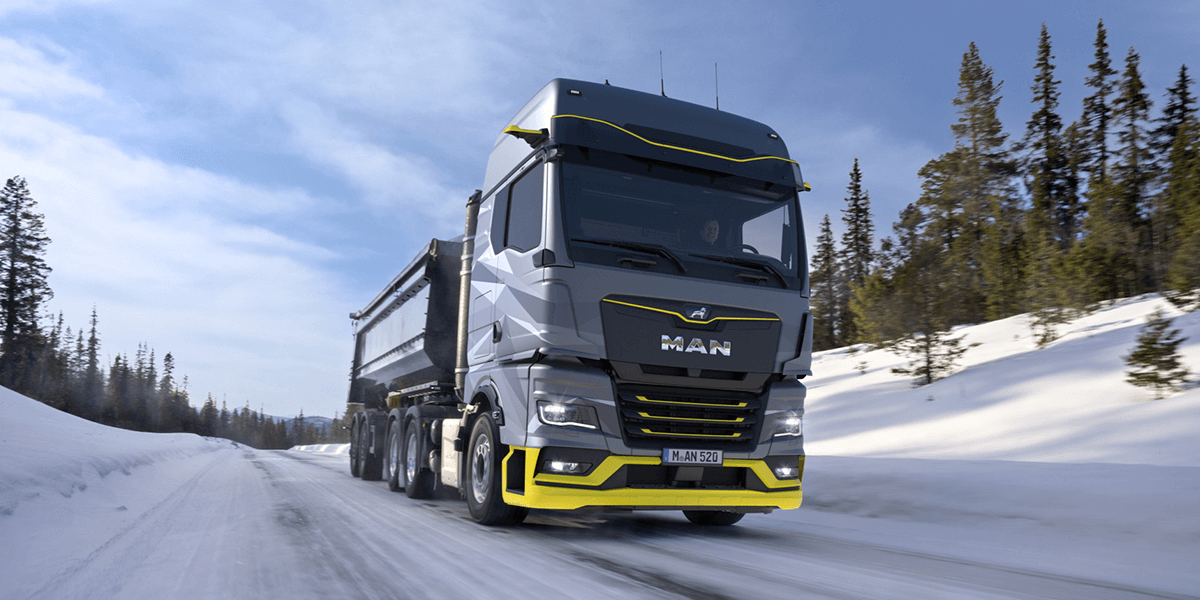
Deploying ZET corridors presents a significant opportunity to take the lead in ZET adoption while realizing its environmental, social, and economic benefits
India has embarked on a journey towards becoming an economic powerhouse, keeping in mind its climate goals and sustainable development priorities. The country’s development hinges on increasing its industrial activities, rapid urbanization and growth in commerce, which depends heavily on movement of goods. Logistics movement, especially through trucks, play a very important role in sustaining this growth. However, as the demand for trucking is expected to increase manifold, it is also crucial for the country to transition this sector towards cleaner solutions, given India’s net-zero targets.
Zero-emission trucks (ZETs), which have zero tailpipe emissions, can play a very critical role in helping the country reach both its economic and emission reduction targets. India is the world's third-largest net importer of crude oil and petroleum products, importing over 80% of the crude oil needs, a significant part of which is consumed by these trucks. Reports indicate that if no action is taken on long-distance heavy trucking by 2050, the emissions from these vehicles in India may account for as much as 15% of the total country's emissions.
These clean vehicles provide a gamut of benefits, starting from reduction in logistics cost to energy security to emission reduction, leading to healthier and cleaner cities. India has already kickstarted its effort to fast track the transition, with the government allocating Rs 500 crore for the purchase of ZETs under the Prime Minister Electric Drive Revolution in Innovative Vehicle Enhancement (PM E-DRIVE) scheme. The initiative is poised to address concerns about environmental pollution and the country’s fuel security, and make significant progress in promoting sustainable transportation solutions.
To fully realise the potential of the initiative, the Office of the Principal Scientific Advisor to the Government of India has proposed several actions, one of which is the creation of ZET corridors with requisite infrastructure that can help initiate and sustain the ZET market in India through demand aggregation. These corridors are highway segments equipped with charging or refuelling infrastructure to facilitate seamless goods movement.
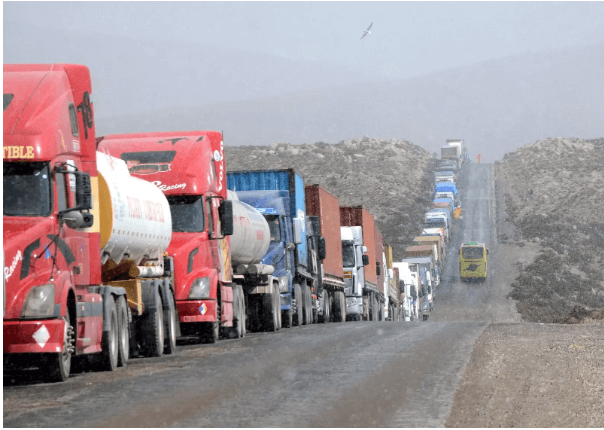 Fig 1: Trucks lined up on a road. Pic Credit: Reuters/APG
According to a report published by the Office of the PSA, “establishing ZET corridors can help ensure the use of truck and infrastructure assets, demonstrate ZET operational and financial feasibility, help manage risks and lower costs, and unlock private capital for ZET projects.” It maintains that both the public and private sectors have already begun working on this aspect and pilot projects are “being announced and implemented in Gujarat, Maharashtra, Tamil Nadu, and Karnataka states.”
After coming out with a “Technical Roadmap for Deployment of Zero-Emission Trucking in India” in 2023, the office of the PSA has now undertaken the initiative to identify the top corridors for ZET deployment in the country, providing a deep dive into the process and key activities undertaken for corridor identification. Let us now analyse the roadmap towards identifying and establishing key ZET corridors across India recommended by the report.
Roadmap Towards Identifying Critical ZET Corridors
The report titled “India’s Priority Corridors for Zero-Emission Trucking” envisages dividing the entire process into three phases, starting off first with shortlisting the top 50 corridors across the country through qualitative and quantitative assessment, followed by stakeholder meets to narrow down the priority corridors to 24 and finally undertaking field research to identify the top 10 corridors.
Phase 1: The report pointed out that around 230 corridors were initially created based on traffic volumes and patterns arising out of good movement on them. “After overlapping corridors were consolidated, the list was reduced to 103,” it said. Various methods were used to prioritise these 50 corridors, that include using toll transaction data or, where toll data was unavailable, satellite imagery.
“Following quantitative filtering, a qualitative assessment was conducted, including stakeholder interviews, identification of alternative transport modes, evaluation of future freight demand, and analysis of industrial activities. This process resulted in a final list of 50 prioritised corridors,” it added.
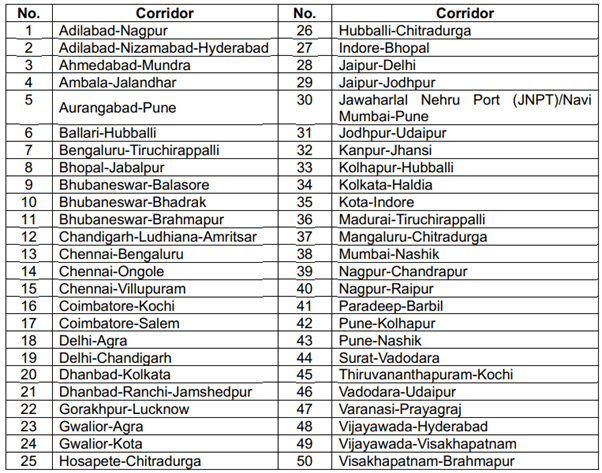 Fig 2: The list of 50 corridors as identified in the first phase. Credit: Office of the PSA report
Phase 2: After the completion of the process of identifying the top 50 corridors, the office of the PSA then hosted an industry roundtable, inviting various stakeholders, to get insights about the real-world scenarios to further short- list the top 20–30 ZET corridors. The report said that stakeholders who participated in the meet “highlighted key criteria for identifying ZET corridors, including truck traffic demand, applicable use cases for ZET deployment, ZET model and infrastructure availability, access to land, favourable policies, and economic viability. Using these key criteria, the stakeholders voted to identify the top 24 corridors,” it pointed out.
Phase 3: The report said that the final stage entailed the evaluation of a corridor’s ZET-readiness level on three parameters – : primary data, secondary data, and stakeholder alignment. “The primary data was collected through field research along each corridor. Through a truck driver and fleet operator survey, factors such as truck traffic pattern, use case, and drivers’ and operators’ awareness around ZETs were considered in corridor selection,” it said.
Thereafter, the secondary data analysis focused on the distribution of key facilities along the corridor that can benefit ZET and charging infrastructure development, such as power lines, substations, logistics hubs, and original equipment manufacturer service stations. The final 10 prioritised corridors where public and industry stakeholders have signalled interest in ZET deployment, it added.
“None of the top 10 corridors have significant elevation gains over short stretches that would require either large battery capacity or numerous additional chargers, contributing to their technological and economic feasibility. Additionally, a sensitivity analysis was conducted by adjusting the weightages of the three parameter groups. The analysis showed that most of the top corridors remained consistent despite changes in weightages,” it added.
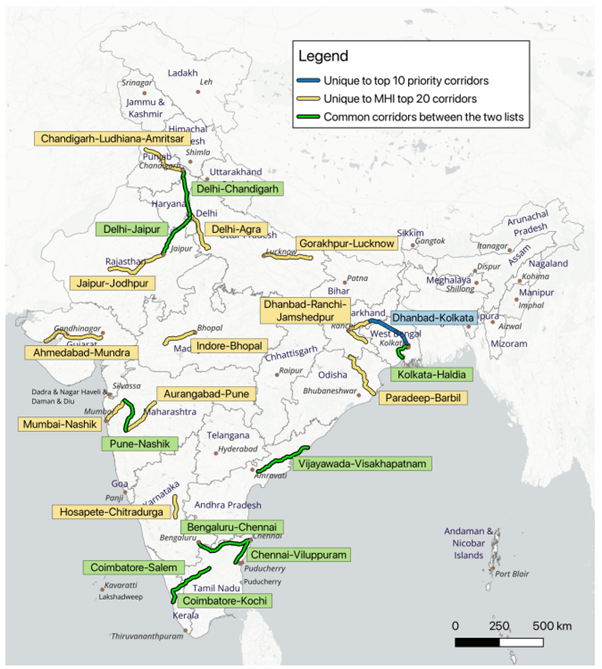 Fig 3: Top 10 priority corridors identified compared to MHI top 20 corridors. Credit: Office of PSA report
The report concluded that “identification of priority ZET corridors is the first key step in corridor development for seamless ZET movement.” It highlighted that the next step is to “develop a corridor pilot case and business plan for each of the top 10 corridors that includes ZET and infrastructure cash flow analysis to demonstrate its financial and operational viability. The top 10 corridors identified through this process present a significant opportunity for India to kick-start and sustain the ZET market and demonstrate leadership in clean transportation.”
Advantages of Zero Emission Trucking In India
Emissions reduction: Since these vehicles do not have any tailpipe emissions, ZET adoption can reduce 2.8–3.8 gigatons of CO2 emissions cumulatively through 2050.
Abating Air Pollution: The adoption of these clean vehicles can significantly bring down Particulate Matter and nitrous oxide pollution by ~40% by 2050, improving public health.
Cost savings: Because of lower fuel and maintenance costs, ZETs can reduce logistics costs by 17% over a vehicle’s lifetime.
Moving Towards Energy security: “Road freight accounts for more than 25% of oil imports annually. Switching to ZETs can displace up to 993 billion litres of diesel, resulting in savings of ₹116 lakh crore by 2050,” the report said.
Industrial competitiveness: The report highlighted that the transition to ZETs will create a cumulative demand of 4,000 gigawatt hours for domestically produced batteries by 2050. “This shift will boost India’s competitiveness in the global battery and ZET manufacturing sectors, positioning the country as a leader in the transition to clean transportation,” it added.
About the Author


