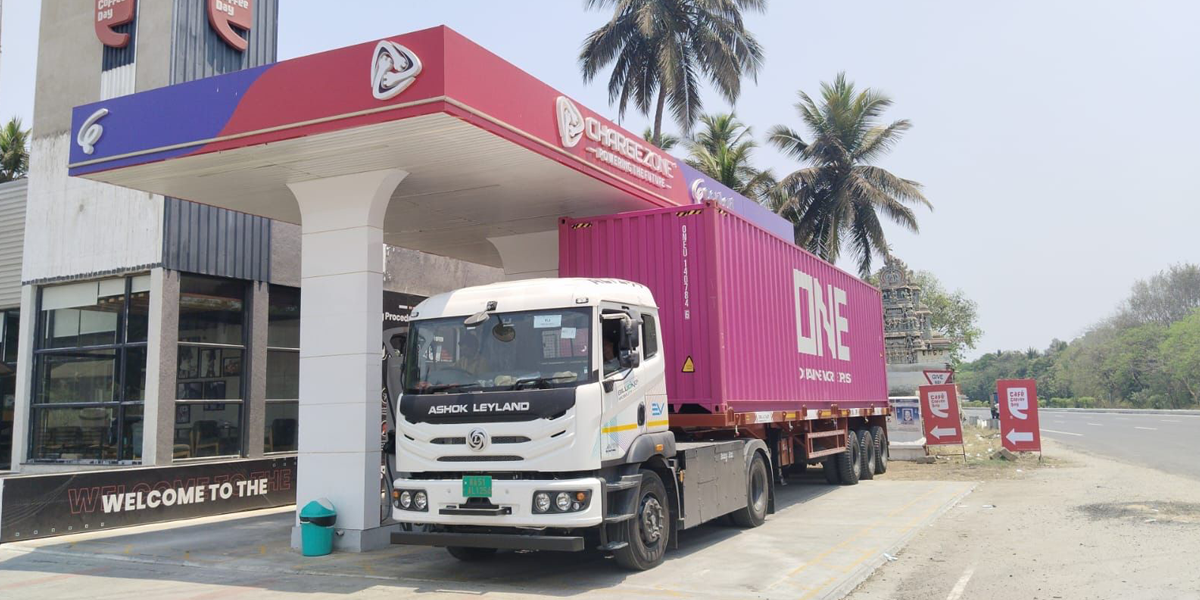
India is poised to make a historic shift towards battery electric trucks (BETs) in its road freight segment, says a new International Council on Clean Transportation (ICCT) working paper, "Charging infrastructure needed to support India's full transition to battery electric trucks by 2050". The paper provides a detailed report on charging requirements for Indian medium- and heavy-duty battery electric trucks, and uses state-level road freight to estimate the country’s charger requirements between 2030 and 2050.
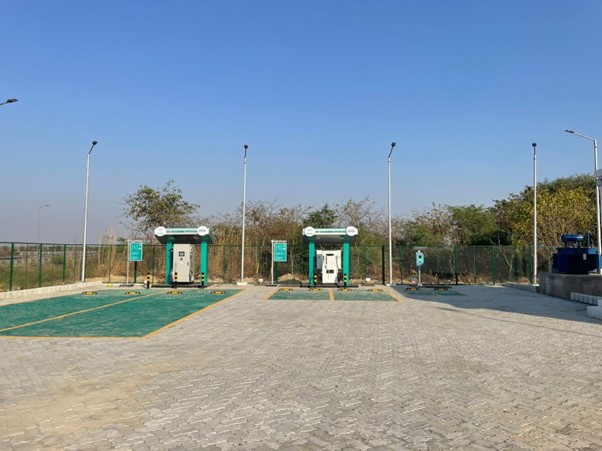 Figure 1: A 240kW charging station at Agra-Lucknow expressway near Etawah| Image credit: Harsh Verma
From Pledge to Policy: India’s Electrification Drive
The shift is underpinned by India's pledge to become net-zero by 2070, made at COP26 in Glasgow. Fortunately, the timing is near-perfect as commercially viable zero-emission technologies are now available at scale, which paves the way for decarbonising trucks that may be used in the hard-to-abate sectors of steel, cement and aviation.
Policy measures that have led the transition :
- Heavy duty fuel consumption standards (April 2023): The Ministry of Road Transport and Highways launched India's first truck fuel efficiency standards.
- PM E-DRIVE programme (October 2024): Introduced by the Ministry of Heavy Industries, the programme allocates ₹500 crore towards subsidizing the purchase of battery electric trucks and ₹2,000 crore for public charging infrastructure for EVs in cities and highways.
- Revised charging infrastructure guidelines (2024): Requires public fast-charging points every 100 km on expressways, with at least one 240 kW charger for buses and trucks, and reduced tariffs during solar hours.
Underpinning these advances are strategic efforts like the Zero-Emission Truck (ZET) Report for Principal Scientific Adviser (PSA) and corridor-specific pilot studies. For example, the Delhi-Jaipur corridor study identified that 70% of trucks made round trips, highlighting the importance of depot-based and en-route public charging facilities. The PSA's office plays a pivotal role in technology evaluation and charting viable routes for BET rollout.
Mapping the Heart of India's Trucking: Corridors and States
The report draws on large amounts of FASTag toll data and highway mapping to recognize freight corridors and state activity. The important corridors covered are:
- Golden Quadrilateral
- North-South and East-West Corridors
- Dedicated Freight Corridors connecting industrial clusters, cement and steel centers, and key ports.
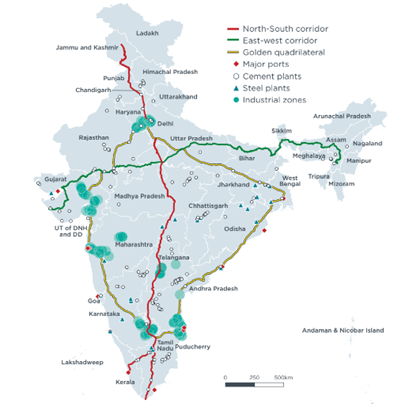 Figure 2: India’s key freight corridors and industrial corridors | Image credit: ICCT
Table 1: Top Trucking States in India (by Daily Energy Demand)
| State | Daily Demand 2030 (MWh) | Daily Demand 2050 (MWh) | % of National |
| Maharashtra | 5,090 | 133,420 | 21% |
| Uttar Pradesh | 4,705 | 123,321 | 19% |
| Rajasthan | 3,122 | 81,825 | 13% |
| Gujarat | 1,951 | 51,142 | 8% |
| Madhya Pradesh | 1,816 | 47,594 | 7% |
Together, these five states represent more than 70% of national BET energy demand, driven by freight intensity, industrial clusters, and connectivity.
 Figure 3: India’s projected daily grid energy needs in 2030 and 2050 (GWh) | Image credit: ICCT
Plan for 2030 and 2050
The report finds that BETs need overnight depot chargers, high-speed highway/public chargers, and ultra-fast en-route chargers, with specs depending on vehicle segment and application. Therefore:
- Nighttime depot and public chargers would have to predominant in initial years because of operational ease and reduced costs.
- Fast and ultra-fast chargers will make opportunity/top-up charging possible on high-volume corridors, particularly for long-distance and time-sensitive logistics.
By 2030, the demand is estimated to be:
- BET stock: 133,361 trucks
- Charger requirements: 43,347 overnight, 26,229 fast, 3,567 ultra-fast chargers
- Installed capacity: 9 GW (compared to 69 GW required in the US)
2050:
- BET stock: 4 million trucks (62% of the fleet)
- Charger requirements: 1.3 million overnight, 293,445 fast, 65,077 ultra-fast chargers
- Installed capacity: 171 GW
Charging demand increases unevenly: Maharashtra alone will require 35 GW and 273,493 chargers by 2050, followed by UP, Rajasthan, and Gujarat.
Policy Recommendations and the Way Forward
ICCT presents a four-pronged policy action plan for an effective transition:
- Develop National and State-level Roadmaps: India’s national vision will need to determine high-intensity corridors, industrial clusters, and truck segments to be prioritized for investment, and coordinating the public and private sector efforts.
- Strategic Grid Planning for High-Capacity Truck Charging: Grid development is essential to facilitate timely roll-out. States need to authorize utility providers to proactively upgrade transformers and substations, simplify interconnection permits, and identify "e-truck ready highways/zones" with pre charging capacity, particularly around logistics centers.
- Bridge Data Gaps and Modernize Freight Tracking: Additionally, India has to increase access to electronic waybill and FASTag data, implement GPS-based tolling, and create a central portal for anonymized logistics data. Baking this into platforms such as Bharatmala and Unified Logistics Interface Platform will reduce forecasting complexity.
- Bake-in BET Infrastructure in Logistics and Zone Planning: BET charging needs to be integrated into master plans for multimodal parks, economic zones, and logistics—based on efforts like PM Gati Shakti and National Logistics Policy. This also involves land reservation, availability of utilities, and GIS-based mapping for total charger deployment.
Challenges that require resolution :
- Economic and Technical Viability: The report emphasizes cost-parity routes as battery costs come down and efficiency increases—estimating as much as 45–50% reduced initial cost in 2030. It notes that operational facts like payload penalties (15–20%), grid bottlenecks, and utilization issues for small fleet operators must be addressed.
- Investment and Financing Gaps: Funding large public high-power chargers and grid improvements continues to be a policy challenge that needs de-risking, innovative partnerships, and blended financing models.
Conclusion
Road freight is a major source of emissions, so decarbonising it to the extent possible would be a major leap forward for India. Electric trucks hold immense potential to lower the sector’s emissions, but making the transition needs sustained investments and public-private collaborations. ICCT’s working paper thus comes at an opportune time and lays out essential data points and perspectives to guide the transition to electric freight.
About the Author


