
The shift to electric vehicles to meet the country’s climate goals will require OEMs to invest a whopping USD 323 billion by 2070 in new technologies and manufacturing
India’s automobile sector contributes around 7% to the manufacturing gross domestic product (GDP), one of the largest in the country, apart from employing a significantly large number of people. But the transport sector was also responsible for about 13% of the country’s total greenhouse gas (GHG) emissions in 2016.
India’s road transport also relies significantly on petrol and diesel and is the country’s largest oil consumer, constituting 44% of total consumption in 2021. Alternative fuels play only a marginal role. Given its significant contribution to emissions, it becomes crucial for India to fast track its efforts to decarbonise this sector, critical to achieve net-zero climate targets.
For this transition, India is likely to depend mostly on electric vehicles, necessitating large-scale investments in manufacturing, new technologies as well as research and development. According to a report by the Climate and Sustainability Initiative, decarbonising this sector could create an “opportunity for growth in the mobility industry, particularly in the case of road-based EVs”.
“The auto sector transition could lead to an overall market creation of more than USD 19.7 trillion by 2070, with cars accounting for 63 per cent of the market and contributing nearly USD 15.5 trillion,” said the report titled “India’s Auto Industry: Mapping the Course to Net Zero by 2070”. The report argues that this transition will require a “multi-pronged approach, including strategic infrastructure development, technological innovation, consumer financing solutions, and robust policies”.
 Fig 1: Two people ride past the Red Fort in New Delhi on March 25, 2022, on Ather electric scooters. Representative image. | Photo Credit: Ather Energy/Unsplash
Investments Needed To Facilitate The Transition
The report states that Original Equipment Manufacturers (OEMs) will require to invest a whopping USD 323 billion to produce EVs alongside existing technologies, thus generating revenues of USD 14.1 trillion for them until 2070. “The largest share of investments – amounting to around USD 263 billion until 2070 – is likely required in the four-wheeler category,” it pointed out.
Truck manufacturers are anticipated to invest over USD 45 billion by 2070 to meet domestic demand, the report said, adding that the transition of the automobile sector is also expected to generate a revenue collection of USD 4.1 trillion in Goods and Services Tax (GST) for the exchequer during 2020–2070, it adds.
“Further, to meet the calculated annual battery demand of around 1,716 GWh by 2070 and achieve complete domestic production, manufacturers will have to invest USD 196 billion until 2070,” the report states. It estimates that the overall demand for batteries for all electric vehicles can be met domestically via 172 giga-factories, of 10 GWh capacity each, by 2070.
Given the present status of financial hand holding for consumers to make the switch to electric vehicles, the report found that there needs to be a significant increase in vehicle loans. India would require vehicle loans worth USD 9.6 trillion until 2070 to achieve this transition, it points out. “The volume of auto loans for new vehicles would need to increase over 20 times from around USD 20 billion in 2020 to over USD 410 billion annually by 2070,” the report said.
“Auto loan portfolios would need to grow at an annual rate between 6–18 per cent over the next two decades. Policymakers and regulators will need to provide support to ensure that financing keeps pace with sales, or else the transition may falter,” it adds.
Financing Solutions For The Transition of the Automobile Sector
In the short term, the report advocates replicating the model of the Credit Guarantee Trust for Micro and Small Enterprises (CGTMSE), which the Small Industries Development Bank of India (SIDBI) hosts for SME loans provided by participating FIs. “This could allow automobile financiers to provide better terms of finance for the purchase of EVs,” it said.
Another possible short-term solution would be the green line credits that will allow on-lenders to make loans that are more “attuned” to the EV category and its usage, the report argues. Focusing on other segments of the EV landscape like the charging infrastructure, the report suggests policy makers to consider “alternative financing solutions” that includes providing “accelerated depreciation for fleet and charging point owners, thereby incentivising the uptake of EVs and encouraging investment in the charging business”.
Among the long-term solutions, the report proposes collaboration between the auto financier and OEMs for providing extended warranty and maintenance packages. “A guaranteed buyback option” for certain EVs offered by these firms can also appeal to consumers in terms of an assurance of a buyback value, the report said. “”Given the scale of financing required, options like annualisation/subscription and leasing can help support the FI fund the purchase of EVs,” it added.
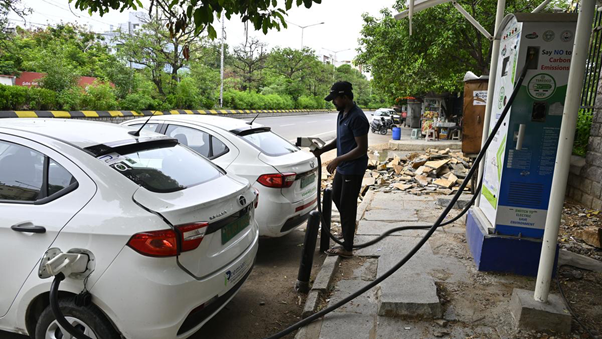 Fig 2: A person uses an EV charging station installed by Greater Hyderabad Municipal Corporation and Telangana Renewable Energy Development Corporation Ltd in Hyderabad on June 20, 2024. Photo Credit: Nagara Gopal
Current Automobile Market In India
The progress made in the transition to electric vehicles in India have been predominantly led by the two-wheeler segment with sales contributions of 14–21 million units annually over the last six years between FY19 to FY24, while passenger vehicles have contributed 3–4 million units over the period. “The other significant contributors are three-wheelers (3Ws), which added 0.3–0.7 million units annually in sales between FY19 and FY24; commercial vehicles, including trucks, smaller vehicles, and buses, which added around 0.6–1 million units in sales to the total auto market, which varied between 18–26 million units in annual sales during this period,” the report adds.
Electric two-wheelers (E-2Ws) were a key major contributor to EV sales over FY22, FY23, and FY24, with annual sales of around 0.25, 0.73, and 0.94 million units, respectively. During these years, E-2Ws contributed 2, 4, and 5% of the total two-wheeler sales. In a first in FY23, the total number of EVs sold surpassed the million sales mark, with the sale of 1.2 million EV units, the report said.
The EV two-wheeler and three-wheeler categories are likely to achieve a double-digit revenue share in 2025– 2030, with a projected increase to 31% and 25%, respectively, the report said. “We expect the EV OEMs’ annual revenue to increase from USD 1.6 billion in 2025 to around USD 502 billion by 2070. By 2030, it is estimated that EVs will contribute 7.5 per cent of the total OEM automobile sales revenue. After 2030, we expect cars to become the largest revenue contributor, contributing over USD 8 trillion in sales during 2020–2070, accounting for 83 per cent of total EV revenues,” the report said.
The sale of electric trucks are also expected to rise between 2050 and 2070, making it the second-highest contributing sector to electric OEM revenues, accounting for 8% of the total. “We expect it to contribute over USD 834 billion to the estimated total EV sales–related revenue of around USD 9.6 trillion,” the report added.
About the Author


