
To truly unlock the next phase of electric mobility, especially in the two-wheeler category, industry players and policymakers must prioritise interoperability
Are We Solving the Wrong Problem?
For years now, the electric vehicle (EV) industry-especially in the two-wheeler space-has been attempting to outpace “range anxiety.” More battery capacity, real-time indicators, and smarter dashboards have become the go-to solutions. But the real question is – is range anxiety truly the biggest hurdle? Yes, but it’s because of the lack of a wider charging network. Most electric two-wheelers rely on proprietary charging systems that can’t be used by other brands, making charging inconvenient and inconsistent.
A closer look reveals a deeper issue - charging interoperability. It’s not that electric riders don’t have enough range; it’s that they don’t have a unified, easily accessible way to recharge their vehicles. This is particularly evident in the electric two-wheeler category, where proprietary charging networks are becoming more of a bottleneck than the range itself. While electric four-wheelers (E4Ws) continue to gain momentum, electric two-wheelers are struggling to scale in volume. Interestingly, this difference stems less from technical capabilities and more from the ease-or lack thereof-of charging.
The Fragmented Reality of E2W Charging in India
The Indian E2W sector is full of promise, innovation, and ambition. Yet, when it comes to infrastructure, it is fragmented to the point of inefficiency. Most manufacturers deploy closed loop charging systems, meaning their charging stations work exclusively for their own vehicles. These setups often come with brand-specific connectors, power ratings, and mobile apps. For a rider, this means limited access to charging infrastructure - even if a nearby station is physically available, it may not be compatible with their vehicle.
The user is forced to navigate through multiple apps to locate a usable charger, which results in unnecessary complexity. Meanwhile, these exclusive stations often remain underutilised because only a fraction of riders can access them. This model, while perhaps useful during early development phases, has now become a serious hindrance to widespread EV adoption.
 Fig 1: Dinesh Arjun is the co-founder and CEO of Raptee.HV
E4Ws Are Moving Faster - Thanks to Interoperability
In contrast, the electric four-wheeler segment in India is progressing at a much faster rate. Despite the higher upfront cost of E4Ws, their adoption is being fueled by one critical enabler - interoperability. Most electric cars in India today support standardized connectors such as CCS2 and are compatible with multiple public fast-charging networks, including those operated by Tata Power, Zeon, Glida, Statiq, and even some multi-brand fuel stations. This provides electric car users with the flexibility to charge almost anywhere, without worrying about brand-specific constraints. As a result, charging becomes a natural part of vehicle use, rather than a calculated risk.
Because electric four-wheelers adopted common charging standards early on, several private players—many of them completely unrelated to OEMs - entered the charging ecosystem. These independent charging service providers helped accelerate infrastructure growth and accessibility across the country. Unfortunately, this ecosystem effect didn’t occur in the E2W space, as most two-wheeler brands chose to install their own proprietary charging networks, creating closed loops that limited expansion and interoperability.
The data underscores this trend. According to VAHAN data as of 2024, India has over 1.15 million registered E2Ws. However, a significant portion of these are low-speed models with removable or swappable batteries and limited infrastructure support. On the other hand, electric four-wheelers have shown a year-on-year growth of over 90% in FY24. Brands like Tata Motors, which support interoperable charging standards, are leading the charge-literally and figuratively. Clearly, ease of charging – not just range or performance-is a key factor influencing adoption.
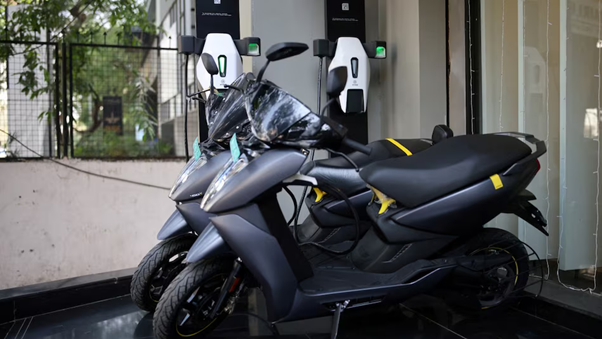 Fig 2: Electric two wheelers at a charging station: Pic credit: reuters
Enhancing User Experience Through Shared Infrastructure
Charging infrastructure doesn't need to be this fragmented. The introduction of a common charging protocol for all brands could completely transform the EV landscape. With shared infrastructure, every public charger becomes accessible to any vehicle, thereby maximising utilisation and reducing redundant investments. Integrated apps and on-screen vehicle dashboards could display all available charging stations in real-time, regardless of brand.
This not only makes charging more convenient but also improves long-distance and urban usability. Payments, too, could be simplified through a unified system - such as UPI or a centralised wallet-eliminating the need to maintain multiple brand-specific apps or payment modes. Ultimately, a universal system would allow riders to plan their trips with confidence, knowing that charging is accessible, visible, and easy to use.
The electric four-wheeler segment already offers a preview of this future. Charging apps like Tata Power EZ or Glida integrate chargers from multiple networks and allow seamless, secure payments. For the user, this makes EV usage feel intuitive, tech-enabled, and well-supported-everything an E2W rider currently wishes they had.
Towards an Interoperable E2W Ecosystem: The Way Forward
To truly unlock the next phase of electric mobility-especially in the two-wheeler category-industry players and policymakers must prioritise interoperability. This begins with the standardisation of connectors, voltage protocols, and communication systems across brands. Much like the mobile industry eventually embraced a standardised charging port, the EV sector must agree on shared technical specifications to make cross-brand compatibility possible.
Government schemes such as FAME and PLI can further incentivise or mandate interoperability for charging infrastructure projects. In parallel, it is essential to build a shared digital layer that supports real-time charger discovery and unified payments. Instead of having separate apps for every Charge Point Operator (CPO), there must be an integrated payment system that allows users to locate and pay for charging—irrespective of the CPO—through a single, seamless interface. This backend system should be accessible from any vehicle cluster or app, giving users a consolidated and accurate view of nearby stations. Finally, the two-wheeler industry must learn from the four-wheeler segment and adapt best practices in interoperability, tailored to their specific power and form factor requirements.
Conclusion: It’s Time to Shift the Narrative
Range anxiety may have once been the central fear in EV adoption, but today it is a red herring. The more urgent and fixable issue is the lack of charging interoperability-a challenge that limits both convenience and confidence for users. A future where all brands share common infrastructure, apps, and payment systems will not only boost adoption but also elevate the user experience. If India wants to see millions of electric two-wheelers on the road, it’s time to stop building walls and start building bridges. Interoperability isn’t just good for business-it’s essential for progress.
Dinesh Arjun is the co-founder and CEO of Raptee.HV
About the Author


