

If the momentum of the past year is any indicator, the future of EVs in India is not just bright; it is electric!
2024 has proven to be a truly transformative year for the global electric vehicle (EV) sector. The year marked a slew of ambitious advancements and new challenges that saw a collective push toward a greener future. Yet, as we celebrate milestones, we must also recalibrate our efforts for the road ahead. This reflective transition and forward momentum are more than mere industry imperatives.
They have become societal necessities for operating in a world set against the backdrop of climate imperatives, energy insecurities, and ever-shifting consumer dynamics. The Indian EV landscape, in particular, continues to offer a rich microcosm of global trends by blending innovation with practical ambition and affirmative action.
A year of breakthroughs and bold statements
The EV narrative in 2024 was anything but static. It was a year that saw significant technological advancements, regulatory boosts, and evolving business models. India, a nation with a burgeoning appetite for electrification, crossed several key milestones. Take the domestic electric compact SUV, for instance. This wasn't just another car---it was an emphatic statement. Middle-class families were suddenly seeing electric vehicles not as some distant dream, but as a practical, exciting choice sitting right in their driveways.
The government's FAME-II (Faster Adoption and Manufacture of Electric Vehicles) initiative played a crucial role in accelerating EV adoption. Launched in 2019, this scheme provides financial incentives for electric vehicle purchases and supports the development of charging infrastructure. It offers substantial subsidies that can reduce the cost of electric two-wheelers by up to 40% and electric four-wheelers by up to 20%, making EVs more affordable for the average consumer. The initiative also focuses on creating a robust ecosystem for electric mobility by supporting domestic manufacturing and technological innovation.
Globally, battery technology saw some remarkable strides. Sodium-ion batteries which are considered a cost-effective alternative to the lithium-ion ones also gained considerable traction. Startups from Bangalore are pioneering this space as they promise faster charging and longer-lasting solutions tailored for India's climatic conditions. Meanwhile, several global and local automakers have launched EVs targeting the luxury market. This aptly demonstrates that the electrification journey spans each and every segment of the automotive spectrum.
Financing The EV Revolution
Sustainable financing has emerged as a pivotal enabler behind these developments. The convergence of EV growth and green finance has spurred a symbiotic relationship where the success of one fuels the other. Indian banks and non-banking financial companies (NBFCs) have stepped up to offer tailored loans for EV purchases at competitive rates. For instance, a leading national bank's "Green Car Loan" scheme saw increased traction by offering favorable terms to EV buyers. Such initiatives while reducing the financial barriers for consumers also align with the larger global Environmental, Social, and Governance (ESG) goals.
On the industrial side, companies are leveraging green bonds and sustainability-linked loans to fund expansion. A prominent power infrastructure company, for example, raised substantial capital to develop its sprawling EV charging network; a move that reiterates the role of sustainable finance in scaling infrastructure. These efforts also align with India's broader commitment to achieve net-zero emissions by 2070 as outlined at COP26.
Challenges And Roadblocks
Yet, the journey has been far from seamless. The EV sector in India continues to grapple with infrastructure gaps that are more evident in rural areas. While urban centers like Bangalore and Delhi possess robust charging networks, tier-2 and tier-3 cities continue to lag behind. Moreover, the high cost of EVs remains an obvious deterrent for many potential buyers despite subsidies.
Battery recycling and disposal also emerged as pressing concerns. Innovative recycling companies are pioneering solutions to recover valuable metals from used batteries. However, the scale of operations being immense requires significant expansion. Additionally, geopolitical factors such as the dependency on certain countries for critical components highlight vulnerabilities across the entire supply chain which necessitates a more proficient and agile domestic manufacturing capacity.
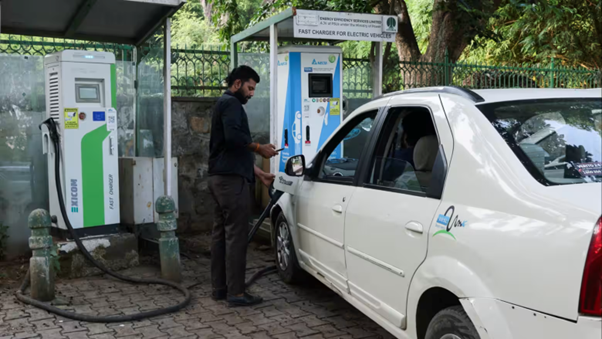 Fig 2: A man plugs in an EV at a charging station in New Delhi. Pic credit: Reuters
The road ahead
As we look to 2025 and beyond, the EV sector finds itself at an inflection point. The focus must shift from early adoption to mass-scale integration. This entails not just producing more vehicles but breeding a comprehensive ecosystem that includes reliable infrastructure, accessible financing, and robust regulatory frameworks.
One promising development is the rise of battery-swapping models. Innovative companies are championing this concept which could address both the cost and infrastructure challenges in India. By decoupling the battery from the vehicle, this model offers flexibility and affordability that particularly benefits commercial fleets and last-mile delivery services.
India's push for local manufacturing under the "Make in India" initiative is another critical driver. The recently launched Production-Linked Incentive (PLI) scheme for Advanced Chemistry Cell (ACC) batteries aims to reduce dependency on imports and boost domestic innovation. If successful, it could redefine India's position in the global EV supply chain.
Sustainable finance will continue to be the backbone of this transition. The integration of ESG metrics into corporate strategies will not only attract global investors but also ensure long-term viability. Major automotive companies are leading by example, having instilled sustainability into their core business models while expanding their EV portfolio.
Closing Thoughts
The EV sector's trajectory mirrors a broader narrative of resilience, innovation, and collaboration. The year gone by has evocatively outlined the enormous possibilities when technological ingenuity meets policy support and financial innovation. But the journey ahead will demand more vision, more investment, and more inclusivity.
As India positions itself as a global leader in e-mobility, the lessons learned in 2024 provide a genuine roadmap. They remind us that while the road to net-zero is long, each step counts. Every milestone achieved, whether a new EV model launched, a charging station inaugurated, or a financing scheme implemented brings us closer to a sustainable future. And if the momentum of the past year is any indicator, the future of EVs in India is not just bright; it is electric!
Sameer Aggarwal, Founder and CEO of Revfin
About the Author


