
An IEA report projects that around 1.2 million electric vehicle batteries could reach the end of their lifetime in 2030, and 14 million by 2040
The global appetite for lithium ion-batteries is growing at a pace that would have seemed very extraordinary even a decade ago. Driven by the twin engines of electric mobility and renewable energy storage systems, these batteries have become synonymous with clean energy transition globally. In developing countries, including India, the rapid scaling of EV adoption across all vehicle segments is translating into millions of battery units entering the market every year.
Globally the numbers are more staggering than ever. The demand for these batteries are expected to multiply several times over the next decade as electrification increases across various segments like transport, industry and energy systems. According to a report by the International Energy Agency and European Patent Office, the market size of li-ion batteries expanded to “more than five-fold to 1 100 GWh by 2024” from “around 180 GWh in 2020”. This is projected to reach more than 3 500 GWh by 2030.
The rapid growth in the use of lithium-ion batteries presents a looming global challenge: every battery manufactured today will eventually reach the end of its service life. With the installed base of these batteries expanding at an unprecedented rate, the disposal and management of spent batteries is transitioning from a distant worry to an immediate, critical priority for policymakers and industry alike.
The report highlights that “around 1.2 million electric vehicle batteries could reach the end of their lifetime in 2030, and 14 million by 2040.” This is a waste management concern that will need to be addressed. “In addition, today’s supply chains for battery materials and components are highly concentrated, weakening supply resilience and economic competitiveness in some regions, while raising environmental questions about mining sustainability in others,” said the latest report titled “Battery Circularity – Innovation Trends for a Future Source of Critical Minerals”.
It argued that battery circularity, that includes recycling, reuse of batteries in vehicles and repurposing of batteries for new applications, as a technology has emerged as a key option that can help overcome these hurdles. In the process, it can also recover a substantial amount of critical minerals. The report highlighted the main locations of patenting, the leading patentors in the world and the technology categories receiving the most innovation attention. Let us look at five key takeaways from the report.
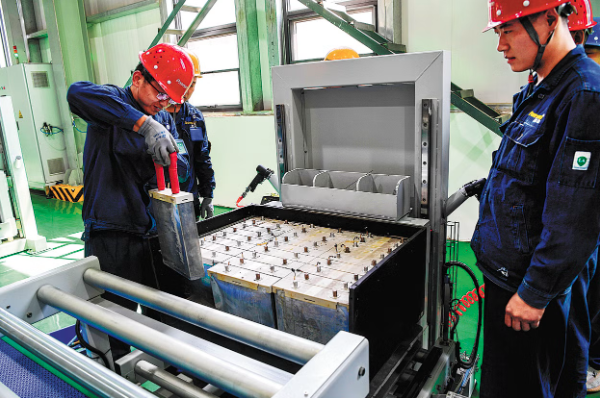 Fig 1: Employees arrange spent batteries at a battery recycling plant in Weinan, Shaanxi province, in August, 2021 (YUAN JINGZHI / FOR CHINA DAILY)
Innovation
It said innovation in battery circularity has been growing at a rapid pace. Noting that patenting is the key indicator of technological change and energy technology patenting is today led by battery innovation, the report said “the share of energy patenting represented by energy storage reached 40% in 2023, and data indicate that it is heading towards 50%. To our knowledge, no other energy technology has ever commanded such a dominant share.”
“Since 2017, international patent families (IPFs) related to battery circularity recorded a compound annual growth rate of 42%, compared with 16% for battery-metal refining technologies and 2% for all technical fields.1,2 In 2017, global sales of electric cars broke the one million mark, and it became widely accepted that electric vehicle (EV) sales would continue to grow, becoming a major share of the global car fleet.”
It said governments in Europe and China, between 2013 and 2018, introduced legislation to make companies responsible for electric vehicle batteries at the ends of their service lives, “providing additional incentive to innovate the means of recycling and get patented approaches enshrined in evolving industrial standards.”
Asia’s Monopoly
“Patent analysis shows that Asia – and China in particular – has emerged as the leading region for innovation in battery circularity technologies. While Europe and North America continue to generate important, globally relevant inventions, in 2023 Asian applicants accounted for 63% of IPFs in the field. The companies that patent the most in this field are mostly patenting technologies related to the collection of used batteries and the recovery of metals through chemical transformation,” the report highlighted.
China’s Dominance
In the realm of battery circularity and the refining of critical metals for batteries, China now holds the dominant position.“This single country dominates the supply of 19 out of 20 refined critical minerals for the energy sector. Since 2020, China’s share of IPFs in the field of battery metal refining has equalled that of the United States, reflecting its rapid expansion in an industry that has traditionally been dominated by large mining interests,” the report pointed out.
The increase in Chinese patent applications for this technology is even more dramatic when considering all applications, including those submitted in only one national jurisdiction. China's share of national patents has surged from approximately 10% in the early 2000s to an average of around 70% of all national and international patents globally over the five years leading up to 2023, it said.
At the same time, the report highlighted that Chinese applicants are increasingly looking to international patent protection. “Since 2018, the share of IPFs among all global patenting has almost doubled from a low point of 10% to around 20% in 2023. Just as the low point was driven by an expansion of Chinese national patents, the turnaround has been led by more Chinese inventions being patented in multiple regions rather than with Chinese national patents alone.
Europe’s Focus on Pre-processing Batteries
During the reporting period, European entities consistently represented approximately 20% of all international patent families related to battery circularity.
“European applicants are particularly active in collection and chemical transformation, with a focus on areas such as remote handling technologies (European applicants account for 34% of IPFs in this field), as well as isolation and immobilisation (30%) and hydrometallurgical extraction following pyrolytic pre-treatment (26%). This focus reflects Europe’s potential to manage growing volumes of used batteries,” the report added.
About the Author


