
Recycling of used EV batteries will not only bring down the overall cost of production, but will also reduce the intensity of mining of minerals.
The electric vehicle industry is undoubtedly evolving rapidly. Surveys have shown that people are now warming up to the idea of plugging-in their vehicles and making bold choices for the environment. However, there are many challenges before the EV industry actually matures.
It is estimated that about 90% of the lithium-ion battery market will be driven by electric vehicles by 2030. According to a Mckinsey report, global demand for li-ion batteries is expected to touch 4,700 gigawatt hours (GWh). Out of this, EVs will account for about 4,300 GWh by the end of the decade.
Growing Evolution of the EV Industry and its Environmental Impact
This will generate a huge amount of EV battery waste. The wasted batteries would be a serious threat to the environment as well as those dealing with them. A sustainable way to deal with these issues is to recycle and reuse the batteries. This will not only bring down the overall cost of production, but will also reduce the intensity of mining of minerals. But this requires creation of an organised secondary market for end-of-life cycle EV batteries. This secondary market can be lucrative as the growing EV adoption is expected to create 1.2 million tons of recycling opportunities by the end of this decade.
 Fig1. There is a need to find better techniques to recycle end-of-life EV batteries. Image via Reuters
When EV batteries degrade by 20-30%, they are no longer suitable for electric vehicles. But their left over 70-80% capacity is still suitable for second-life (stationary) applications, such as telecommunications, data centre backup services, renewable-energy-powered EV charging stations, and low-power EV applications.
However, out of all the retired lithium-ion batteries available as of 2020, about 70% are either dumped in landfills or not received for recycling. About 20% are recycled in the unorganised sector. Out of the remaining, 5% are recycled in the organised sector, and 5% are exported for recycling, according to a report by the World Resources Institute India.
Challenges in the Current Battery Recycling Landscape
Since the Indian battery recycling industry is dominated by players from the unorganised sector, which collects the majority of the retired batteries, there is a huge safety concern for people working in the industry during the recycle process. This issue was discussed during an event hosted by WRI India and it threw up several safety challenges. Some of them are listed below.
- Unorganised sector: The safety challenge starts with the collection of retired batteries for reuse and recycling. Absence of an organised sector for this has become a major concern for safety of workers and of the environment. Currently, those working in this sector do not adhere to safety guidelines. A system for data collection and sharing is needed to be able to trace batteries from the cradle to the grave.
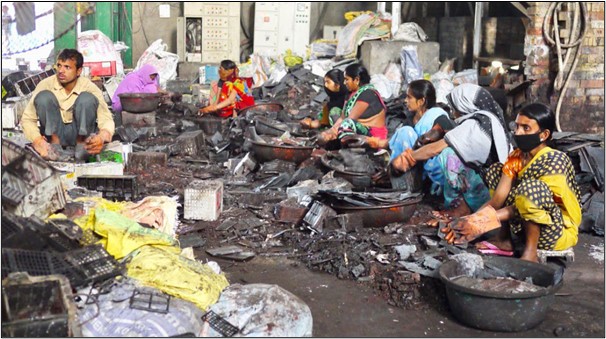 Fig 2. The safety of people collecting retired batteries for reuse and recycling should be high on the agenda. Image via Pure Earth
 - Gaps in policies and regulations: The second-life application potential of batteries is discussed in the Draft Battery Swapping Policy. It is imperative to implement this policy as soon as possible because EV battery waste is going to increase significantly in the coming years.
- Transportation and storage: The lack of standards and safety measures for the storage and transportation of EV batteries makes the reverse logistics process unsafe and challenging.
- Dismantling and refurbishment: Dismantling involves processes that can potentially result in mechanical abuse of the battery and thermal runaway in the battery, thus creating a hazardous situation.
- Human resources: A skilled workforce or automation is needed to recycle batteries. Currently, India does not have enough skilled workers or any design standardisation for the adoption of automation in reuse and recycling of li-ion batteries, making the whole process inefficient.
- Public awareness: There is a need to increase consumer confidence in buying refurbished or reused batteries. Consumers often have safety concerns about the second-life application of batteries. So raising their awareness in the safety of second-life applications of batteries is needed.
Recycling Solutions for EV Battery Waste
The current structure of the battery packs makes it hard for the battery to be dismantled for reuse and recycling. So it needs to be simplified for potential reuse and dismantling as a feature. But there should be no compromise on safety. The use of some fire-resistant material in the battery pack needs to be mandated for the battery safety throughout the primary and secondary application.
A mechanism needs to be developed to evaluate the remaining life of battery packs discarded from electric vehicles. A set of assessment criteria needs to be prepared for each application and the ideal second-use application.
Safer logistics and storage systems must be developed because high-power batteries are sensitive to external environmental conditions. All types of lithium-ion batteries get damaged when temperatures are above 55 degrees Celsius.
Adapting to the evolving EV battery ecosystem and making the required changes will go a long way in ensuring that end-of-life EV batteries don’t end up in waste but are used for secondary purposes. The time to act on that is now.

