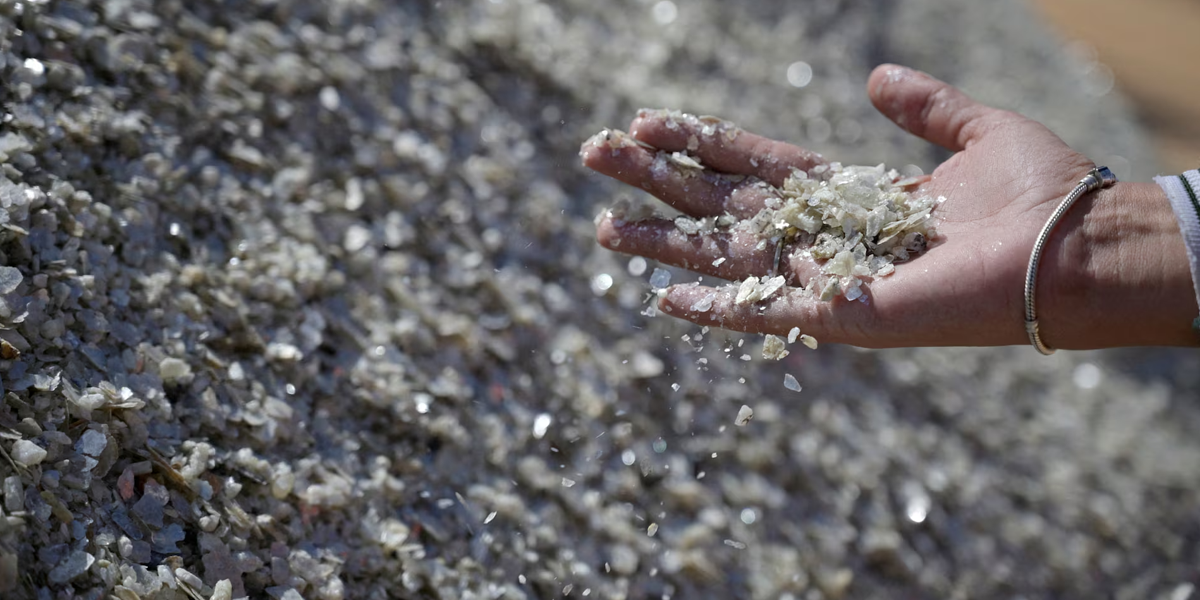
The critical minerals and rare earth trade reached $2.5 trillion in 2023, with Asia emerging as the largest importer
There is a quiet consensus among those who follow the critical mineral supply chains closely; the question is no longer where the resources are situated. Now what matters is who turns those resources into something a factory can use. Critical minerals and rare earths have moved from being a niche mining and industrial policy discussion to the very centre of global geopolitical and economic security conversations.
Lithium, cobalt, nickel, graphite and rare earth elements, all essential for the global transition towards clean and sustainable pathways, are abundant across Africa, Latin America, Central and Southeast Asia. The BRICS+ grouping and its partners hold up to 72% of the world’s rare earth resources and 75% of manganese. Yet global supply chains remain highly concentrated, particularly at the processing and refining stages.
The critical minerals and rare earth trade reached $2.5 trillion in 2023, with Asia emerging as the largest importer. Demand for critical minerals is expected to triple by 2030 and quadruple by 2040. However, China accounts for nearly 70% of rare earth mining and 90% of processing. For most emerging economies, the answer for their low carbon pathway lies in acknowledging that China remains their indispensable partner and a dominant processor.
The recently concluded BRICS summit in New Delhi helped build momentum on creating a “just, fair and diversified” supply chain. It is now central that those commitments should move from declarations to concrete industrial projects. The priority should be local value addition and technology transfer rather than raw material exports. Most importantly, the global south should now negotiate as a bloc to ensure that new capacity is expanded equitably and that the current dependence on exporting ore does not simply give way to another form of commodity dependence.
“Dont swap one commodity dependence for another. The question we must ask is critical for who? The risk is you move from exporting one set of minerals to another. Policy makers should think about resilient development and economic diversification,” said Shimukunku Manchishi, researcher and analysts at the Africa Futures Policy Hub (AFPH), during an online interaction titled “Critical Minerals: Geopolitical Chokepoints and Who Controls The Chain” organised by Climate Trends.
During the webinar, experts from South America, Africa and India weighed in on the recent momentum built during India’s BRICS presidency on critical minerals and discussed the practical way forward in building a “just and sustainable” supply chain.
 Fig 1: An aerial view shows the brine pools of SQM lithium mine on the Atacama salt flat in the Atacama desert of northern Chile, January 10, 2013. REUTERS/Ivan Alvarado/File Photo/File Photo
Framework for Value Addition
Experts identified the midstream segment as the primary choke point at present. “The midstream requires carbon-intensive electricity with emission levels on the higher side. In this scenario, experts called for a dedicated BRICS Critical Minerals Fund that can enable specifically ring-fencing capital for processing infrastructure in resource-rich nations.
“There is a need for a dedicated BRICS Critical Minerals Fund, which could be, for any part of the value chain. But we haven't seen momentum on that front. As far as the processing infrastructure is concerned… We can address this particular choke point through the creation of a fund. Now the problem of exploration is somewhat being solved. But it’s the processing where a lot of technologies are required, which not all countries possess uniformly,” said Meheli Roy Choudhury, Research Associate, critical minerals, Chintan Research Foundation (CRF).
She also observed that processing plants should be established in regions with abundant clean energy to reduce the high carbon footprint associated with refining nickel, graphite, and rare earths. Other experts argued that active regional industrial policies, including potential export bans or taxes are required to force the development of local capacity.
A Middle Path With China
China remains dominant across several critical mineral value chains. Its use of export controls and other unilateral supply chain measures have demonstrated how such concentration can acquire geopolitical dominance. This concern – “weaponisation of technology and critical minerals” – was also flagged by Indian Prime Minister Narendra Modi during the BRICS summit.
The issue, therefore, presents itself as a sort of conundrum for global south countries who want to both diversify away from China but also somehow remain dependent on its expertise. How does one do it? Experts pointed out that diversification should not be viewed as decoupling while there is a need to acknowledge the scale at which China operates as far as critical minerals are concerned.
A "middle path" involves using Chinese technology under license in plants with local or even Indian equity in particular cases, mandatory local hiring targets, and time-bound technology transfer agreements, they pointed out, adding that to make technology transfer effective, states must invest in skilled labor, local suppliers, and research institutions to avoid simply importing technology without building national capability.
“We need to be smart about it. We will definitely not throw away China, because that's not possible. There's obviously a geopolitical battle which is beyond us. We have to be smart about it and see where China can fit into our industry, our processing goals, and so on,” Manchishi pointed out.
Luisa Bianchet, analyst on transition diplomacy with a focus on BRICS and critical minerals at the E+ Energy Transition Institute in Brazil argued that a realistic approach towards China will be better suited for BRICS+ countries at this juncture.
“China holds most of the technology for processing cathodes and cells, and it's already investing in our countries. Chinese battery companies are investing in different countries. Excluding China is neither possible nor in our interest. We have a lot of capital involved in this equation. The question is on what terms China participates. Our countries should negotiate as a group, where possible, and set conditions such as joint ventures with local partners, training, local suppliers, development, and local research and development,” she said.
Critical Mineral Supply Chains: What Role Does India Play?
Experts pointed out that India can bridge the gap by combining its automotive manufacturing scale and experience with Africa's minerals and Latin America's growing EV markets. At the same time, India must shift from deploying existing technology to innovating homegrown battery and EV tech to avoid long-term dependency on external supply chains.
Sumati Kohli, Researcher, International Council On Clean Transportation (ICCT) said while India has been ramping up its efforts in the electric mobility segment and getting more EVs on the road, there has not been much emphasis on developing homegrown technology. She said if India does not innovate and bring new technologies into the ecosystem, we are going to continue to be dependent on other countries which are already controlling the value chain.
“This is something which is within the capabilities of India because India. The only gap is the translation of the innovations in universities to actual on-ground implementations through their adoption into OEMs producing EVs. The only way for India to take advantage and reduce its dependency is to give a lot of trust and importance on research and development,” Kohli said.
Critical Minerals and The COP
The experts argued that despite becoming so crucial to the global economy, when it comes to the UNFCCC’s annual Conference of Parties (CoP), critical minerals currently lack an official negotiating track at the annual summit. They said it is important to move these discussions from “voluntary presidential initiatives into mainstream negotiating platforms.”
They also argued that the National Determined Contributions (NDCs) should be used to measure how critical mineral commitments translate into domestic transition efforts.
Bianchet said at the COP30 in Brazil last year, while tracking the just transition negotiations, the Africa group proposed to include a paragraph on critical minerals and the value addition in the final text, but that was not agreed upon.
“It happened mainly because China didn't want to talk about that in the COP ecosystem. At COP31, I don't think we will talk about critical minerals. We will talk about electrification, which is a way to approach Transitioning Away From Fossil Fuels (TAFF). But the topic will not appear. However, next year, the COP will take place in Ethiopia. I believe adaptation and critical minerals will have an important place,” she added.
About the Author


