These rules can foster confidence in the government’s commitment to reducing vehicle emissions and encourage vehicle manufacturers to invest in the ZEV transition
The road transport sector sits at the centre of a rapidly evolving mobility landscape in India, backed by robust policy support and incentives. However, this accelerating growth has come with profound environmental and public-health consequences, contributing significantly to road emissions. As the power grid shifts to renewable energy, thanks to India’s focus and fast pacing of its clean energy transitions, delivering clean, breathable cities and achieving India’s commitment to reach net-zero by 2070 requires a decisive shift toward zero-emission vehicles (ZEVs).
Keeping this in mind, India has been accelerating its shift towards decarbonisation of its transport sector. The Indian government has come up with an ambitious objective for electric vehicles (EVs), aiming for them to constitute 30% of all new vehicle sales by the year 2030, with elevated targets under consideration for specific vehicle segments. Despite not being mandatory, it aligns with the country’s aim to promote ZEVs while representing a strategic industrial opportunity of positioning India as a global leader in next-generation automotive technologies.
Although government financial subsidies for ZEV buyers, manufacturers, and charging providers have catalyzed early electric-vehicle adoption, sustaining purchase subsidies at scale, however, has become increasingly expensive, putting a significant burden on the coffers. It has also not significantly pushed the market for mass adoption, which requires huge financial resources.
In this scenario, a study by The International Council on Clean Transportation argues that Supply Side Regulations (SSRs) are poised to play a critical role in increasing ZEV adoption in India. “SSRs could help accelerate India’s ZEV transition at a low cost to the government. These regulations, which include performance-based regulations like fuel efficiency and CO2 standards as well as ZEV sales requirements, can foster confidence in the government’s commitment to reducing vehicle emissions and encourage vehicle manufacturers and other sectors to invest in the transition to ZEVs,” it says in its study “Optimizing supply-side regulations to advance India’s zero emission vehicle transition.”
 Fig 1: Vehicles drive on a highway on a polluted smoggy morning in New Delhi, India, November 7, 2024. REUTERS/Anushree Fadnavis/File Photo
How Can SSRs Help In Scaling Up ZEV Adoption In India
The study argues that SSRs require manufacturers to sell ZEVs at “increasing rates, encouraging more investment and competition and providing a predictable environment” to develop the supply chains, which costs less to the government.
“Integrating lessons learned from other markets related to policy design elements like target structure, super credits, credit trading, and penalties for non-compliance could make India’s regulations best-in-class and help to achieve the country’s ZEV goals. As the Government of India considers new fuel consumption standards or ZEV sales requirements, it can leverage lessons learned from other markets,” it said.
It makes the case for having frequent or a yearly tightening of standards instead of long gaps like a five-year period to encourage consistent expansion in the EV market and supply chains. “Super credits could be phased down to encourage consistent year-over-year ZEV sales growth as cost parity approaches. A trading system could enable greater flexibility for manufacturers while providing a revenue source for manufacturers committed to ZEVs, including prominent Indian companies. Finally, penalties for non-compliance could be indexed to the gap between the target and a manufacturer’s performance to promote fairness and avoid perverse incentives,” the study pointed out.
Elaborating on examples in the European Union, United Kingdom, and the United States, the analysis said that increase in investments in ZEV supply chains can yield similar economic benefits in India.
“The European Union’s adoption of extended carbon dioxide emission standards in March 2023 was followed by approximately €5 billion in announced investments in ZEVs and battery manufacturing by companies like BMW Group, Stellantis, and CATL,” it said.
Similarly after the start of the ZEV mandate in the UK in 2024, investments amounting to roughly £6 billion were announced by Ford, Tata Group, Nissan, and JATCO for ZEV and upstream manufacturing within a span of two years. “Adopting well-designed SSRs in India could increase investment in ZEV manufacturing, battery production, and charging infrastructure from domestic and foreign companies. Domestic manufacturers committed to ZEVs could further benefit if trading schemes were included in the SSRs, creating a new source of potential revenue to expand operations,” it said.
Driven by financial subsidies provided by government schemes like the FAME, PM E-Drive and others, India is fast becoming one of the top markets for ZEV manufacturing and purchasing. However, “SSRs could be an effective complement to this policy mix by requiring manufacturers to sell ZEVs at increasing rates, thereby encouraging more investment and competition and providing a predictable environment for developing supply chains,” it argued.
Across the world, adoption of SSRs has proved to be a major tool to attract investments in ZEVs. “Adopting SSRs may position India to similarly attract investments in ZEV manufacturing, helping it to increase output and employment in the auto manufacturing sector and to achieve a higher market share of global vehicle production. Driven by concerted policy and innovation by Indian companies, India appears poised to become a global leader in the transition to ZEVs, promising substantial economic benefits alongside reductions in air pollution and GHG emissions,” it pointed out.
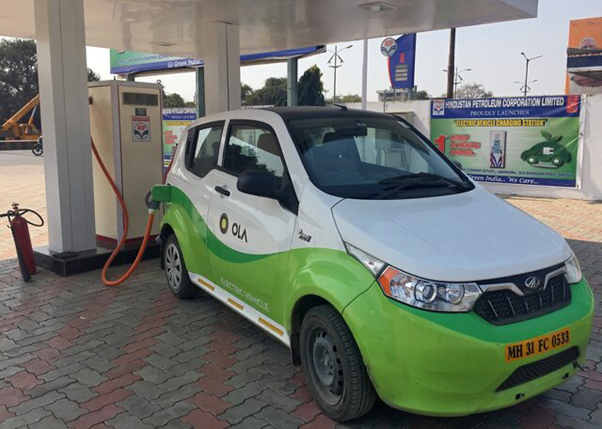 Fig 2: Mahindra's e2oPlus, operated by Indian ride-hailing company Ola, is seen at an electric vehicle charging station in Nagpur, India January 24, 2018. Picture taken January 24, 2018. REUTERS/Aditi Shah
Measures Adopted by India to Increase ZEV Adoption
- Faster Adoption and Manufacturing of Hybrid and Electric Vehicles (FAME) scheme: This was introduced in 2015under the National Electric Mobility Mission Plan (NEMMP) 2020. The NEMMP 2020 was envisaged to position India as a leader in the ZEV market, particularly in the two and four-wheeler segments. The scheme was implemented in two phases.
- The Electric Mobility Promotion Scheme (EMPS): Thereafter, the government launched this scheme from April-September 2024, focussing on providing short-term measures to accelerate ZEV adoption for a limited number of vehicles in the two- and three-wheeler segments.
- PM E Drive: In October 2024, the government introduced the PM Electric Drive Revolution in Innovative Vehicle Enhancement (PM E-DRIVE) initiative, which provides incentives for the purchase of electric two- and three-wheelers, buses, trucks, and ambulances, as well as funding to expand charging infrastructure and build the capacity of testing agencies.
About the Author


