
Despite a rise in the number of women occupying positions across the automotive sector hierarchy, a lot more needs to be done to create a more inclusive gender-equal workforce
The automotive industry has been consistently undergoing a transformation, embracing cutting-edge technologies and pushing the mobility landscape towards sustainability. The shift from Internal Combustion Engine (ICE) vehicles to electric and emergence of breakthrough technologies like automated driver assistance technology (ADAS) have also helped expand employment opportunities for women in the industry that has mostly been dominated by men.
As the EV ecosystem in India gains traction owing to the government’s consistent push for adoption of these vehicles and growing consciousness among consumers towards green and sustainable mobility options, women have also started finding their ‘long overdue’ space in this industry and are not only stepping up in leadership roles but are also actively handling manual activities such as products and technology development and operating machines to maintain a vehicle, apart from getting involved in various other segments like research and development and marketing, especially in the EV sector.
A white paper by the OMI Foundation has found that there has been a rise in the number of women occupying positions across the automotive sector hierarchy - from shop floors to middle management to C-suite jobs. Currently, women already account for 11-15% of the overall EV workforce of 1.1 crore in India which is likely to reach 50% by 2030-33.
“With industry-level initiatives, women can increasingly be found on EV shop floors in the job roles of assembly line operator, assembly technician, apprentice trainee, production associate, machine operator as well as in profiles across security, welding, general assembly, product testing, and battery manufacturing,” it said.
There has been a rise in the number of women getting hired in the mid-level managerial positions as well between 2022-23 and 2023-24. “The data for campus hiring for 2023 indicates fresh talent hired from colleges and institutions constitutes 20% to 25% of the total talent hired in the design domain, with 30% of them being women in roles such as design engineering, development, and computer-aided design and drafting (CADD),” it said, adding that at the directors and C-suite executive level, the representation of women stands at 12-15%.
 Fig 1: The Tata Safari and Harrier are assembled at an all-women assembly line at the Tata Motors Pune plant. Pic credit: Tata Motors
Automotive Industry: Bottlenecks In Increasing Women’s Participation
Despite recognising the need for gender equality and providing equal opportunity to women, the job market remains imbalanced due to many factors, prominent among which is perhaps the limited existence of robust policy enablers, both at the central and the state level, that promote participation of women. The white paper finds that most state policies lack explicit pro-gender references, with only five state EV policies introducing provisions for women till date.
“Although many state policies offer subsidies to promote job creation in the EV sector, they often lack specific incentives for women, which may perpetuate gender disparities. Punjab stands out by offering higher employment generation subsidies for companies, providing Rs 48,000 per year for each woman employee compared to Rs 36,000 per year for each male employee, both for a period of three years,” it adds.
Barring a couple of states, most policies lay stress on skilling but limit the access of women to training and jobs by not focussing on their aspirations. Also for the EV sector which is hugely dependent on small and locally sourced components, there is little recognition of separate incentives like fixed capital investment (FCI), reimbursements of SGST, stamp duties and power costs, rebates in land costs etc. for women-owned micro and medium scale businesses.
Among other things, women also have to face certain challenges in terms of procuring driving licence for vehicles due to “lack of information” in many cases, apart from facing some stringent criteria for becoming bus drivers, the white paper argues. Women entrepreneurs also faced financial issues, with many unable to secure funding from institutions due to “lack of collateral”.
“Moreover, women entrepreneurs often encounter difficulties in accessing venture capital (VC), which is more readily available to male-led businesses, compelling them to rely on microfinance loans and self-help groups for financial support. Less than 3% of the VC funding goes to women in the country,” it said.
There are other aspects which are equally challenging for women. For example, dependence on contractual jobs is a cause of concern for women as it prevents them accessing several benefits given to a permanent employee. Despite significant achievement in this sector, gender pay disparities also remain prevalent, the study said.
“A significant socio-cultural barrier for women in the EV sector is the prevalence of stereotypes and cultural norms that discourage them from pursuing careers in STEM (Science, Technology, Engineering, and Mathematics) fields…A critical barrier to increasing gender diversity in the EV sector is the lack of awareness among women about EVs as a viable and rewarding career option,” it points out while talking about many other barriers.
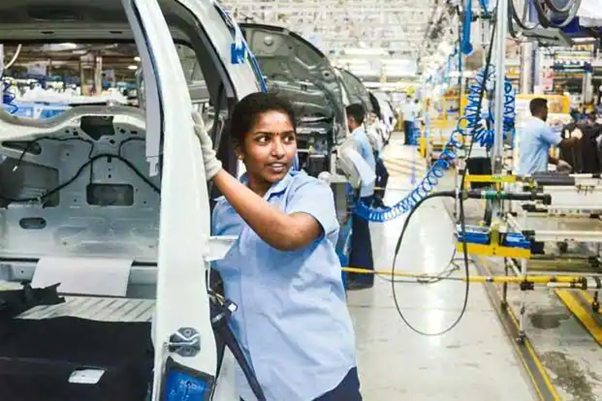 Fig 2: A worker at the Ford factory near Chennai. Photo: Nathan G/Mint
Increasing Women’s participation in the Electric Vehicle sector: Way Forward
Although a lot of strides have been made to bring equitable distribution of jobs in the EV sector, the road remains long and riddled with certain barriers that need to be overcome to truly unleash the true potential of the industry and ensure equal participation of women.
- Policy Support: To promote gender inclusivity, states formulating their EV policies should provide subsidies that support women-led businesses. ‘Gender sensitive employment generation subsidies’ to foster job opportunities across skilled, semi-skilled, and unskilled categories of women should also be a focus area.
Various governments can also “assign higher weightage points to bidders with greater women workforce participation” across the entire EV value chain, thus leveraging procurement as a policy tool.
“This approach can be extended to the procurement and installation of EV infrastructure, battery manufacturing and recycling, among others,” the white paper said, adding that implementation of Fixed Term Employment (FTE) can also enable the hiring of women workers on a fixed-term basis. States can also deploy gender-responsive disaster recovery plans and policies to address the socio-economic impacts of environmental crises to mitigate job losses among women.
- Skilling: On-the-job training programmes initiatives, already started in many states, can enable participants to split their time between classroom instruction and job training which will enable them to acquire requisite skills along with getting a stipend. While skilling institutes can offer choice-based residential skill training programmes, “industry associations can deploy leadership programmes for advancement of women into senior management positions.“Higher scholarships or case-specific fee waiver for short-term courses is another option for increasing the enrolment of women in training institutes”, while the government can collaborate with the industry to upskilling programmes tailored made for women. The training institutes can opt for blended learning solutions combining online education with offline resources and support services.
- Support Services: Convenient and safe pick-up and drop-off services for women employees, accommodation with canteen facilities at subsidised rates for them, providing child care assistance (crèche), a buddy system for returning mothers, counselling services, separate women's washrooms are among a host of other facilities that can be provided to women workers.
- Awareness Generation: Targeted initiatives can empower women to pursue STEM education, skilling courses, and employment and entrepreneurial opportunities. Public awareness campaigns at the grassroots level to enhance the knowledge of skilling programmes among women, organising talks for students at the school level regarding existing career prospects, mentorship programmes, and establishment of incubation centres in colleges in collaboration with the EV sector players as part of corporate social responsibility (CSR) can help foster gender diversity in the sector.
- Financial Hand Holding: “Financial institutions can provide interest-free loans for the first three years to women buyers who want to own an EV for livelihood purposes,” the white paper said. To reduce entry barriers, lending can be ratcheted up for women entrepreneurs by providing tailored loan products featuring flexible terms and low-collateral requirements. Apart from these, the white paper also recommends implementation of accelerator programmes specifically tailored for women-led startups.
About the Author


