
India stands at a pivotal moment in its clean energy journey. Fueled by Net Zero ambition for 2070 and determined NDC targets—a 45% reduction in carbon intensity by 2030, and 500 GW of non-fossil electricity within the same decade—policy momentum is stronger than ever (MoEFCC, 2023). The Viksit Bharat @2047 vision ties these threads together, emphasizing inclusive prosperity, energy security, and climate resilience.
While road transport electrification makes headlines, the backbone of rural India—the agricultural tractor— demands its due share of reform. India remains the world’s top tractor market, edging past 1 million units annually in FY2025. Exports have surged, with 15% of production now reaching 162 countries, reflecting India’s global standing and regulatory convergence.
The Significance of the Tractors in agricultural sector: Sales, Emissions and Health Impacts
Agriculture forms the backbone of the Indian economy, contributing 18% of GDP and employing ~43% of the workforce (Economic Survey of India, 2024). Tractorization has been pivotal in improving yields and rural productivity: tractor density increased from 13 to 54 per 1,000 hectares (2002–2023) and India’s market, valued at $11.4 billion (FY2025) and set to reach $18.1 billion by 2033, is a critical growth driver. marketsandata

Yet this progress comes at a cost. ICE tractors emissions have a considerable share of rural NOx, PM and black carbon emissions. Agricultural tractors and construction equipment together contribute nearly 16% of off-road PM2.5 and a corresponding increase in rural respiratory and cardiovascular disease burden (ICCT,2024). Another strong macroeconomic reason for adopting e-tractors is their ability to lower India’s growing diesel import costs. It is estimated that off-road diesel to be 8-10% of the total India’s annual diesel use and relative fuel import expenses and CO2 emissions. Since agriculture is one of the last areas heavily reliant on diesel, electrifying the tractor fleet will save billions in import costs over time. It will also improve India’s energy security and protect the economy from fluctuations in global oil prices and disruptions in supply due to geopolitical issues. Leading international studies, including those from ICCT, highlight how each electric tractor added helps shield India from fossil fuel volatility. It also supports job creation in rural areas and adds value to the domestic clean energy sector. With over 15% of Indian tractors now exported to 162 countries signaling global competitiveness aligning with international emission standards is both a market opportunity and an environmental necessity (ICCT, 2024)
India’s Clean Energy Policy Landscape: NDCs, Renewables and Agriculture Linkages
Total renewable energy capacity (including large hydro) reached approximately 234 GW by June 2025, representing about 48.3% of the country's total installed power capacity of around 484 GW (Central Electricity Authority, Ministry of Power), strengthens the case for electrifying non-road machinery. Enhanced grid penetration into rural areas, combined with falling renewable generation costs, creates unique conditions for EV adoption (MNRE, 2024). Meanwhile, national directives such as the TREM IV and upcoming TREM V norms mandate emissions alignment with Euro and US standards. This shift, along with renewable energy incentives and air quality missions (NAMP, NCAP), directly impacts the economics and justification for electric tractors (Ministry of Agriculture & Farmers Welfare, 2025).
ICE Tractors in India: Numbers, Export Trends and Emissions Profile
India sold 922,000 tractors in FY2024, with exports growing at a CAGR of 11% since 2009 (Tractor Manufacturers Association, 2024). Top export destinations include the US (21% market share), EU (16%), Brazil, and developing nations across Africa and Southeast Asia. Domestically, >85% of farmers operate small and marginal holdings (below 2 ha), making outright tractor ownership financially infeasible for a majority (Agricultural Census, 2021). This leads to chronic underutilization, high cost-per-hectare, and low mechanization rates in some eastern/northern states.
On health and environmental fronts:
- Tractor dieselization is linked to ambient PM2.5 levels especially during tillage, harvesting, and crop residue management periods, contributing an estimated 6–10% of rural PM2.5 budget (CPCB, 2023).switchon
- Each 50 hp diesel tractor emits ~12 tons CO2 and significant NOx and PM annually under normal operation (~600 hours use/yr) (ICCT, 2024).
- This has direct health implications: a 2022 study in Punjab-Haryana belt showed rural respiratory morbidity rates 27% higher in high-tractor-density districts (MoHFW/ICMR, 2024).
The Need for Tractor Electrification: Market Gaps, Policy, and Technology Readiness
Despite massive market size, India’s electric tractor adoption is nascent:
- Only a handful of domestic OEMs (Cellestial, AutoNxt, Sonalika, Escorts, HAV, FES) have launched e-tractors, primarily in the 20–35hp segment (2023–24), with pilot deployments in Haryana, Telangana, and Maharashtra
- Barriers include upfront price premiums (2–2.5× comparable diesel models), limited rural charging infrastructure, battery degradation under field conditions, and skepticism on torque/endurance.
- Current ICCT and WRI India data suggest that, as of mid-2025, fewer than 150 electric tractors— including prototypes, imports, and pilot project units were registered or operational across India, representing a tiny fraction (<0.01%) of the country’s ~9 million tractor fleet. Large-scale adoption remains a future prospect rather than a present reality.
- Initial trials and pilot deployments for understanding the e-tractors competitiveness for a range of routine farm applications, its instant torque delivery, smooth operation, tasks requiring frequent speed or torque changes such as sowing, spraying or intra-farm haulage, for small and mid-horsepower operations (below 35hp)and demonstrate the ability to complete typical work cycles offering significantly lower running costs, reduced noise and easier maintenance is much need of the hour.
Several states have announced targeted incentives:
- Haryana and Punjab: ₹5 lakhs purchase subsidy for e-tractors, extra for CHCs.
- Maharashtra: ₹4 lakhs subsidy, charging support (2024).
- Odisha, Tamil Nadu, UP: pilot programs in limited districts but no broad-based e-tractor fiscal policy yet.
Despite these, uptake remains weak due to financial risk and lack of peer-reviewed on-ground data.
The E-Tractor Adoption Challenge: Barriers and Structural Issues
- Affordability: High TCO due to battery and tech costs, worsened by limited financing options (most NBFCs restrict lending for experimental assets).
- Technology Trust Deficit: Limited published data on e-tractor runtime, charging resilience, field repairs, and battery life under Indian agro-ecological conditions.
- Utilization Patterns: Agriculture in India is highly seasonal (~110 days/year), reducing scope for amortizing fixed asset costs, especially for smallholders.
- Infrastructure: Rural grid challenges—even where power exists, capacity for high-speed EV charging is rare, especially during peak irrigation months.
- Policy Uncertainty: State support is patchy, pilot outcomes are unpublished, and most farmer cooperatives/FPOs are financially constrained.
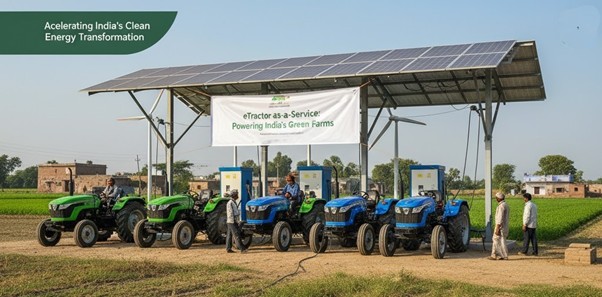 E-Tractor-as-a-Service (eTaaS): Bridging the Gap -Model, Merits and Implementation
eTractor-as-a-Service (eTaaS) can be envisioned to address these structural issues as a start.
- Business Model: Providers (often startups, agri-tech companies, or FPO federations) own/aggregate e-tractors and rent them out to farmers on a per-hour, per-acre or flexible subscription basis. Ongoing operational, maintenance and charging responsibilities are borne by the provider, often with digital booking and usage analytics
- Risk Sharing: Farmers avoid high capex and operational uncertainty; providers leverage asset pooling, predictive maintenance and scale discounts to enhance viability.
- Data and Confidence: Organized deployments generate rich datasets on real-world e-tractor performance, informing further scale and investment.
- Socioeconomic Impact: Marginalized farmers gain access, grassroot entrepreneurs earn as service aggregators, rural jobs and digital literacy rise.
Advantages Over Traditional Models
| Parameter | Traditional | Ownership CHC | (Diesel) eTaaS |
| Capex | High | Medium (pooled) | Low for consumer |
| TCO/Ha | High for small farms | Medium | Potentially lowest via utilization |
| Tech Risk | High (farmer bears) | Moderate | Low for consumer, managed for provider |
| Scalability | Poor | Good | Strong if infrastructure scales |
| Emission Reduction | None | None | Significant (zero tailpipe) |
Policy and Financial Recommendations:
- Scale Public-Private eTaaS Pilots: National and state governments should fund multi-year pilots, with peer-reviewed reporting, across all major agro-climatic zones to validate the model.
- Credit Enhancement for Providers: Mandate PSBs/NBFCs to extend working capital/fleet finance to eTaaS providers via government-backed guarantee funds (NABARD/CGTMSE model).
- Smart Subsidies: Redirect existing e-tractor and mechanization subsidies to “service vouchers” redeemable via eTaaS platforms subsidizing usage not just capex.
- Digital Integration: Partner with agri-tech companies and FPOs for digital booking/payment and data analytics infrastructure, creating a transparent marketplace and supporting outcome-based policy evolution.
- Charging Ecosystem: Co-locate ultra-low-speed rural EV charging stations at FPO warehouses, rural mandis and CHC centres with renewable microgrid pilots (Solar/biogas hybrid).
- OEMs’ engagement: Engaging all leading tractor OEMs in structured, large-scale pilot deployments is critical. By actively initiating/participating in regional pilots and transparently sharing operational, maintenance and productivity data, OEMs can build a strong, trusted dataset for Indian farmers. Such evidence directly addresses prevalent anxieties about e-tractor effectiveness and durability. Demonstrating successful pilots in different agro-climatic zones will provide tangible proof of viability, ultimately foster wider farmer acceptance and accelerating adoption at scale.
Addressing India’s clean energy vehicle transition in agriculture is crucial for both NDC targets and the Viksit Bharat vision, requires pragmatic, technically robust models that reflect local realities. e-Tractor-as-a-Service stands out as a viable, scalable and scientifically grounded pathway that bridges technology, economics and equity. By leveraging this model, India can unlock rural prosperity, enhance air quality, reduce health risks, and cement its global leadership in sustainable mechanized agriculture. The time for systematic, data-driven scale-up is now.

