
Battery electric Heavy Duty Vehicles offer the highest emission reductions among all vehicle technologies available at present
India currently moves a staggering 4.6 billion tonnes of freight annually, with reports estimating these numbers to grow four times by 2050. Most of this hefty lifting is done by Heavy Duty Vehicles (HDVs) that accounted for 58% of GreenHouse Gas (GHG) emissions from on-road transport emissions in 2020.
With rise in demand, emissions from these vehicles, which play a pivotal role in the country’s economy, are expected to rise at a rate of 6% per year to more than 350 metric tons of CO2 by 2050. This will be inconsistent with India’s climate commitments and net zero goals, making it essential to decarbonise the sector which can be achieved through a healthy mix of alternative fuel usage and transitioning to new vehicle technologies like battery electric and fuel cell powertrains.
As pace gathers for transitioning the HDV sector, it also becomes crucial to understand the emission performance of various powertrains and fuels. Therefore, a comprehensive life cycle assessment (LCA) is essential to assess the entire range of emissions associated with technologies across vehicle categories.
The International Council on Clean Transportation (ICCT) undertook an analysis that evaluates the life-cycle GHG emissions of three representative HDVs in India—a 12-tonne rigid truck, a 55-tonne tractor-trailer, and an urban bus—with a mix of different powertrain technologies, including best-in-class diesel trucks, natural gas- fueled trucks, battery-electric vehicles (BEVs), and fuel cell electric vehicles (FCEVs). We look at the five conclusions that the ICCT analysis comes out with.
Battery-Electric HDVs clock the Highest Emission Reductions
In the presently available vehicle technologies, battery electric HDVs offer the highest emission reductions. Across vehicle categories, the analysis found that the life-cycle GHG emissions of BEV HDVs in 2023 are approximately 17%–29% lower than diesel ICE HDV counterparts when fueled by grid-average electricity over their lifetimes.
“However, when powered with dedicated renewable electricity, their emissions are between 78%–83% lower…Greater deployment of renewables and reduced transmission and distribution losses can meaningfully improve the emissions of BEVs already on the road,” the analysis said.
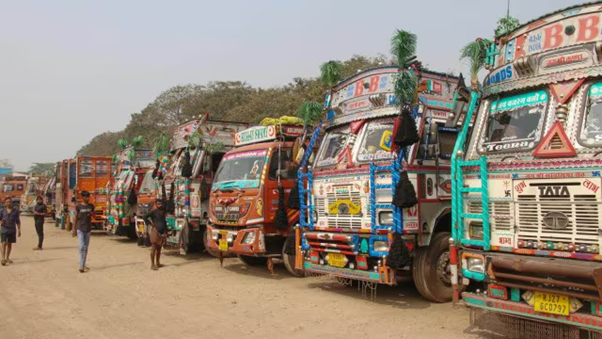 Fig 1: Trucks are parked at the Vashi Terminal. Express photo by Narendra Vaskar
Biofuel Blending: Limited Emission Reduction in HDVs
The Government of India has proposed a target of 5% biofuel blending by 2030. However, despite this target, the lifetime emission reduction is estimated at only around 1% over diesel HDV. “Similarly, increasing biomethane blending to 10% by 2040 also only reduces emissions by approximately 1% for natural gas-fueled HDVs,” the analysis found. Therefore, it only makes sense to focus more on zero emission vehicles in the future.
Modest GHG Reduction in HDVs fueled by Natural Gas
Compared to their ICE counterparts, those HDVs which run on natural gas help in modest GHG emission reduction. “Even assuming more biomethane deployment into the natural gas grid, natural gas-fueled HDVs only provide a marginal benefit in the best of circumstances,” the analysis said.
The analysis said an LNG-fueled 55-tonne tractor-trailer generates approximately the same emissions as its diesel counterpart; a natural gas-fueled 12-tonne truck and urban bus produced in 2023 generate approximately 11%–12% lower life-cycle GHG emissions than their diesel ICE counterparts.
“However, the use of a 20-year global warming potential (GWP) negated the relative emissions savings from grey hydrogen-fueled FCEVs entering the fleet in 2023 compared to diesel trucks, while natural gas vehicles entering the fleet in 2023 generated life-cycle emissions between 9%–23% higher than their diesel counterparts,” the ICCT analysis said.
GHG Emissions: Limited Impact of Blending Hydrogen in Natural Gas
The GHG impact of direct hydrogen blending in natural gas for consumption in ICE vehicles is limited by the source of the hydrogen, the efficiency of natural gas-fueled trucks, and the relatively low energy density of hydrogen. “For an 18% hythane blend using green hydrogen, we estimate a further 10% decrease in emissions for a 55-tonne tractor trailer compared to a standard LNG mix,” it said.
Hydrogen Fuel Cell HDVs: Life Cycle Impact Based on Source of Hydrogen Used
FCEV HDVs fueled with grey hydrogen entering the fleet in 2023 and 2030 have only moderately (11%–18%) lower life-cycle emissions than diesel ICE HDVs. To achieve deeper GHG reductions from FCEVs, vehicle deployment must be accompanied by the deployment of renewable electricity-derived green hydrogen, it said.
“Green hydrogen-fueled FCEV HDVs generate life-cycle GHG emissions roughly comparable to green electricity-powered BEVs (81%–83% lower than diesel), though they consume more electricity over their lifetime due to conversion losses,” it added.
India’s efforts towards decarbonising the HDV segment
The Indian government implemented its first fuel consumption norms for HDVs in 2023. Among other targets, the government also aimed to provide incentives for adoption of electric buses under the second phase of the Faster Adoption and Manufacturing of (Hybrid &) Electric Vehicles in India (FAME). India also aims to increase the “share of natural gas in the energy mix from 6.3% in 2022 to 15% in 2030,” the analysis said.
The National Policy on Biofuels brought out by the government also aims to blend 20% ethanol in petrol (E20) by 2025–2026 and 5% of biodiesel in diesel by 2030. Last year, the government also launched the “National Mission on Green Hydrogen which earmarks financial resources in the national budget towards pilot projects and research and development for promoting hydrogen production technologies such as water electrolysis, steam methane (CH4) reforming, and biomass gasification,” the analysis added
About the Author


