Through its ambitious policies to promote clean mobility solutions and commitment to inclusivity, India is carving a transformative pathway for the Global South
Taking into consideration the rising emissions and increase in catastrophic effects of climate change, India has been leapfrogging towards clean and sustainable mobility solutions by bringing in robust and enabling policies and incentives to handhold the industry and driving the adoption of electric vehicles. India’s sustainability journey was also highlighted at the recently concluded UN Climate Change summit (COP29) held in Azerbaijan’s capital Baku where nearly 200 countries negotiated hard to finally push rich nations to pledge USD 300 billion per year by 2035 to fight climate change.
India’s leadership in clean transportation and electric mobility, through ambitious public policies, private sector initiatives and innovations, and a commitment to inclusivity, came to the fore at COP29 where the country’s narrative of EV innovation, resilience, and collaboration in the fight against climate change through clean transportation solutions like EVs were showcased.
India is one the early movers in this category, realising that to take forward the objectives of the Paris agreement of holding the rise in the global average temperature to well below 2 °C and pursuing efforts to limit temperature rise to 1.5 Degree Celsius, it is essential to decarbonise the transportation sector. Current estimates attribute 21% of global CO2 emissions from burning fossil fuels to transportation globally.
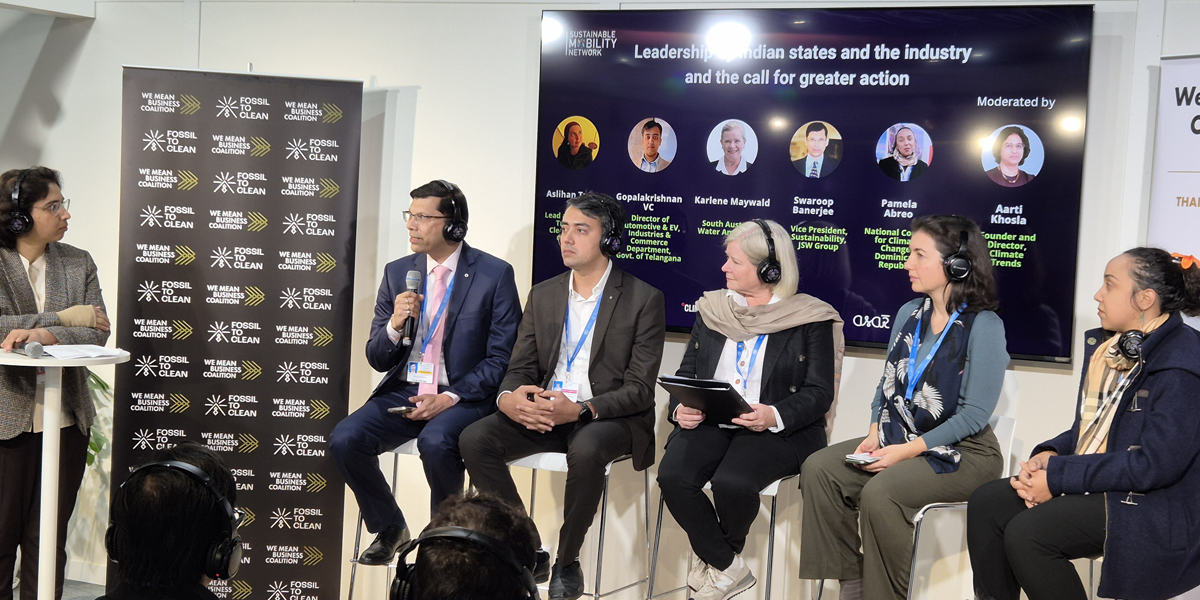
During a session titled “India’s Electric Mobility Leadership: Spotlighting EV Transition Pathways for The Global South” on the Transport Day at COP29, senior delegates from India highlighted how policy enablers are being put in place in various EV segments to scale up adoption as well as case studies and innovative solutions adopted by India that are proving to be the global benchmark in transitioning to clean mobility solutions globally.
India’s Clean Mobility Journey: Stories From The States
Telangana: The state, that is already a hub for manufacturing electric buses and three-wheelers, has renewed its push to fast track this transition and has come out with its ambitious ‘Telangana Mobility Valley’ initiative that aims at laying stress on upscaling their skilling programs, fostering EV innovation and electrifying public transport and last-mile delivery sectors.
It recently announced a 100% exemption from road tax and registration fees for a wide range of EVs registered in the state. This exemption will be in effect until December 31, 2026. The move, many believe, is a crucial step towards reducing the state’s carbon footprint and boosting the adoption of eco-friendly transportation solutions.
“Telangana prides itself on being at the heart of the electric mobility journey in India with our policies and support mechanisms aimed at furthering accelerated EV transition in the state. “In the coming years, this renewed focus by the state government will be pivotal in Telangana meeting its net-zero and decarbonization targets, alongside ensuring a marked reduction in air pollution in our cities,” said Gopalakrishnan VC, Director of Automotive & EV, Industries & Commerce Department, Telangana, at the event organised by Sustainable Mobility Network, a coalition of over 40 Indian think tanks, including Climate Trends, committed to promoting climate-just, inclusive, and accessible mobility solutions across India.
 Fig 1: Attendees at the session “India’s Electric Mobility Leadership: Spotlighting EV Transition Pathways for The Global South” at COP29 in Azerbaijan’s Baku
Karnataka: The state stands out as a leader not only in advancing a robust electric vehicle policy but also in prioritising a just labour transition alongside EV adoption. The state has already sold around 1,15,700 EVs so far in various segments and has been setting a benchmark for impactful and transformative change.
"Our unwavering commitment to electrification is matched only by our dedication to ensuring just and equitable labour transitions. By fostering a mobility ecosystem that not only accelerates decarbonization but also empowers the very individuals who drive our economy, Karnataka is setting a benchmark for impactful and transformative change. This dual-pronged approach defines the uniqueness and power of our EV journey,” said Dr. N.V. Prasad, Secretary to the Government of Karnataka, Transport Department, who was present at the event.
As the first Indian state to launch an EV policy in 2017, Karnataka has built one of the largest EV public bus fleets in the country and developed an extensive EV charging network. At the same time, it has been focussing on supporting gig workers through equitable policies, ensuring no one is left behind. “Karnataka stands at the forefront of India’s electric mobility revolution, championing a vision that is both sustainable and inclusive, " Prasad added.
Not only the central as well as the state governments, the private sector and big corporations too have played a critical role in shaping up the India story. Among the many, JSW, with its presence across the critical EV supply chain, has been playing a pivotal role in decarbonising the Indian automotive sector. In the course of the event at COP29, delegates also got a glimpse of how the conglomerate has played an important role in this transition by introducing innovative models like Battery-as-a-Service (BaaS) which has helped drive adoption.
It is worth a mention here that JSW is venturing into electric vehicle manufacturing, covering both passenger and commercial segments. “As part of our commitment to sustainable mobility, JSW has pledged to electrify its fleet operations by 2040, giving us 15 years to achieve this transition. This commitment is built on two key pillars - demand and supply. We have created in-house demand by setting a target to transition all fleet operations across our businesses to electric vehicles (EVs) within the stipulated timeframe. This decision aligns with our larger sustainability goals and allows us to lead by example,” said Swaroop Banerjee, Vice President, JSW Group.
The event also helped showcase how India’s innovative solutions are setting benchmarks globally. Highlighting this, Aslihan Tumer, Global Coordinator of the Clean Mobility Collective (CMC) pointed out that policies like Delhi’s Fleet Aggregator Policy, which mandates a 2030 transition deadline for delivery fleets are inspiring global action.
How Has The Indian Government Helped Scale Up EV Adoption So far
- FAME Scheme: The Government of India launched the Faster Adoption and Manufacturing of (Hybrid &) Electric Vehicles (FAME) scheme in 2015 to boost the uptake of electric and hybrid vehicles. The first phase (with a budget of Rs 895 crore) operated from 2015 to 2019, while the second phase (with a budget of Rs 11,500 crore) was from 2019 to March, 2024. The Electric Mobility Promotion Scheme (EMPS) with a budgetary allocation of Rs 500 crore was thereafter introduced by the government.
- PLI Schemes: The Ministry of Heavy Industries under the Government of India has two PLI schemes that incentivise the production of EVs - PLI for Advanced Chemistry Cells (ACC) and PLI for Automobiles and Auto Components (AAC). These schemes provide subsidies to EV, advanced EV battery and EV component manufacturers, based on their production capacities.
- Focus on Zero Emission Trucking: India has already announced a unique High Level Ambition Group (HLAG) that will work with the government towards framing a comprehensive policy towards zero freight emission in the country. Prominent OEMs have also come together under the Zero Emission Vehicles Emerging Markets Initiative (ZEV-EMI) and the government's E- FAST (Electric Freight Accelerator for Sustainable Transport) programme to advance the electrification of trucks in India.
- PM E-DRIVE: PM Electric Drive Revolution in Innovative Vehicle Enhancement (PM E-DRIVE) aims to introduce targeted approaches to facilitate this transition. With an outlay of Rs 10,900 crore for two years, the scheme not only aims to streamline the buying process of EVs for the consumers, but also paves way for integrating electric vehicles in the health sector by deploying e-ambulances.
About the Author


