
Having a robust domestic processing capacity backed by a well designed incentive architecture is a vital insurance policy against geopolitical and supply-chain shocks
Critical minerals are now central to sustainable development and geopolitical positioning. The developments over the past several months have underscored a decisive shift in India’s strategic priorities, bringing critical minerals, resilient supply chains and calibrated self-sufficiency at the heart of its economic and energy policy.
India's ambitions in clean energy, electronics, and advanced manufacturing have been quietly hostage to its dependence on imports of critical minerals, with China towering as the dominant supplier across the global supply chain. Realising this, New Delhi has accelerated its push to build a self-reliant mineral ecosystem from the ground up, one that reduces exposure to geopolitical chokepoints and secures the raw material backbone of its industrial future.
In the critical mineral supply chain, more than the supply of raw materials, it is often the processed forms that are valued more. It is at the processing stage where value is created, supply chains are controlled and strategic alignments are forged. Such a scenario makes it essential for a country like India to have a robust domestic processing capacity backed by a well designed incentive architecture.
Recently, government officials confirmed that India is in the advanced stages of finalising a scheme for processing of critical minerals. This is aimed at reducing India’s dependence on processing overseas while retaining more value within the country. Reports suggest that despite getting access or acquiring these critical minerals, which are essential for clean solutions and defence technologies among a host of other things, most of the processing is done outside the country. This scheme will aim to plug that gap.
Officials have said that lithium available in other countries are not being imported owing to the lack of domestic processing value chain. The geopolitical imperative for this intervention is critical.
China's current control over the global processing capacity for essential critical minerals is overwhelming. This dominance is the result of a deliberate, decades-long national industrial strategy, marked by sustained state investment and targeted acquisitions. The ramifications of this market concentration have become evident: recent export controls by China on materials like gallium have severely disrupted global supply chains and exposed the strategic vulnerability of nations.
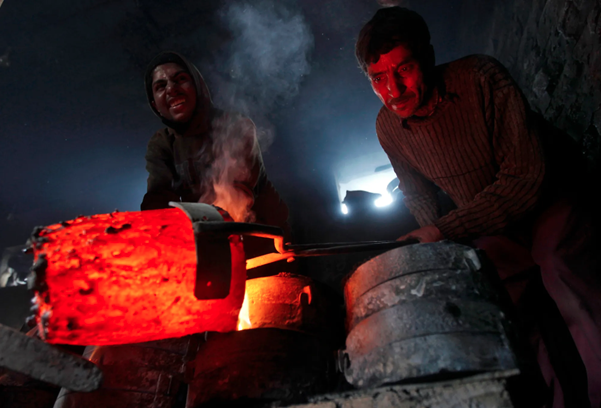 Fig 1: Workers pour melted copper in a mould to make utensils and accessories inside a workshop in Srinagar March 27, 2014. REUTERS/Danish Ismail
For India, this dependence on a single major processor poses an unacceptable strategic risk, especially as the country simultaneously develops its renewable energy sector, scales up electric mobility, and expands its defense manufacturing base. In this context, an incentive scheme to bolster domestic processing is a vital insurance policy against geopolitical and supply-chain shocks.
The government has already announced the establishment of ‘Dedicated Rare Earth Corridors’. This comes in the backdrop of a scheme approved by the Union Cabinet in 2025 to boost the domestic manufacturing of sintered Rare Earth Permanent Magnets (REPM). This is a crucial component for EV traction motors and various other automotive uses. With a total financial outlay of Rs 7,280 crore, the REPM scheme aims to build 6,000 metric tonnes per annum (MTPA) of integrated manufacturing capacity.
India has also entered into bilateral agreements with mineral-rich countries such as Australia, Argentina, Zambia, Mozambique, Peru, Zimbabwe, Malawi, and Côte D’Ivoire. India is also part of the Indo-Pacific Economic Framework (IPEF), which includes cooperation on clean energy and critical mineral supply chains.
About the Author


