
Growing e-bus deployment is creating fresh opportunities to deepen capabilities across the domestic manufacturing ecosystem
India’s electric bus transition is entering a phase in which the question is no longer how quickly buses can be deployed but how much of the value created by that transformation can be retained within the country. Public transport is emerging as one of the strongest early use cases for electrification, supported by large scale government procurement, improving vehicle economics and growing interest from sub-national transport undertakings.
The PM E Drive scheme alone provides a significant sum for the procurement of a record number of electric buses while the broader PM e-Bus Seva programme has already created substantial state level demand. The expanding market in this segment also brings in a key opportunity of establishing the local manufacturing ecosystem. Electric buses bring together several layers of the automotive and energy value chain that includes conventional chassis and body manufacturing to batteries, its management systems, traction motors and a whole lot of other components.
India already has significant capabilities in several of these areas. Newer investments in power electronics, motors, charging systems and other EV-specific components are beginning to deepen the ecosystem. Therefore, the pertinent question remains how localisation can advance most rapidly and where strategic interventions can unlock the next layer of domestic value creation.
According to a recent study by the International Council for Clean Transportation (ICCT), India aims to reach 40% penetration of electric buses (e-buses) by 2030. Supported by various schemes and initiatives of the government to spur manufacturing, it predicts that as demand grows, the localization of key e-bus components has emerged as a priority for policymakers. “Particular focus has been placed on powertrain and battery systems, which together account for more than 60% of the total cost of an e-bus today, although this share is expected to decline as battery prices fall.”
The study titled ‘Electric Bus Market Readiness in India: Status of Localisation’, provides an in-depth assessment of the status of, and prospects for, localization of powertrain and battery component production in India. Based on an assessment of current and projected localization by Foresee Advisors, it offers detailed cost and component breakdowns, identifies areas of high import dependence, and maps out opportunities for strategic import substitution by 2027 and 2030. Let us delve into some of the key takeaways of the study.
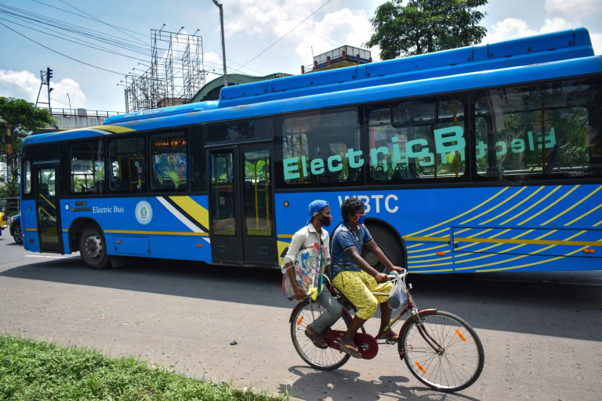 Fig 1: In Kolkata, India, electric buses and bicycles share the road. The city aims to deploy 2,000 electric buses by the end of 2025. Photo: papai/Shutterstock
It maintains that powertrain components such as electric motors remain heavily import-dependent, particularly due to reliance on imported rare-earth magnets, high-performance semiconductors, and advanced microcontrollers. “For electric motors, while components like the shaft, housing, and bearings show moderate localization with domestic suppliers such as Bharat Forge, SKF India, and Endurance Technologies, components like the stator and rotor are still mostly imported,” it said.
A similar story can also be seen in regards to motor controllers which are also “import-intensive, with semiconductors, microcontrollers, capacitors, and inductors sourced predominantly from global suppliers.”
“Although domestic assembly exists, India lacks domestic semiconductor fabrication capacity. However, recent investments signal the potential for improved local capabilities by 2027–2030. Components such as transmissions and thermal management systems show higher degrees of localization, with Indian firms already manufacturing gears, differentials, and cooling systems at scale,” the study noted.
On battery localization, it said cells and cathodes are the most cost-intensive and import-dependent components in the battery value chain, accounting for the majority of a battery’s cost. “Despite some domestic assembly, India currently imports almost all battery cells, mainly due to the country’s lack of raw material supply (e.g., of lithium, cobalt, and nickel) and cell manufacturing plants. Even within battery packs and modules, housing and cooling systems show only moderate localization, with significant reliance on imported sensors and microcontrollers for battery management systems (BMS),” it said.
The findings of the study also highlighted that strengthening India’s domestic e-bus manufacturing ecosystem will require investments in “battery cell research and development and gigafactory-scale manufacturing.”
“Although India has made considerable progress in localizing the production of structural and mechanical components, it still relies heavily on global supply chains for high-value, technologically advanced parts in both the powertrain and battery systems. India’s e-bus ecosystem is on a promising trajectory, but achieving cost competitiveness, supply chain resilience, and technological self-reliance hinges on accelerating the localization of core EV components,” it said.
If policy certainty, industry investment and market scale move together, the electric-bus transition could become an important industrial story in its own right: one in which decarbonising public transport also strengthens India’s manufacturing capabilities, creates new technology businesses and positions domestic suppliers for opportunities beyond the Indian market.
About the Author


