
India remained the third-largest electric bus market for the second year in a row while momentum in electric 3W sales continued to build in the country
India’s electric vehicle market has been on a sustained upward trajectory, with sales climbing consistently across segments despite challenges faced by the automobile industry in the past owing to post Covid supply chain pressures and demand fluctuations. The cumulative EV registrations in India have crossed significant milestones in recent years, backed by a combination of policy measures, state-level incentives and robust domestic manufacturing.
The ongoing West Asia crisis has added fresh urgency for this transition. The disruption of the Strait of Hormuz has driven crude prices sharply and led to a significant increase in India’s oil import bill. Given this scenario, the case for reducing fossil fuel dependence has moved from long-term policy to a more immediate priority, positioning electric mobility at its centre.
Apart from electric cars, the appetite for this transition globally has also been seen in other segments, starting from electric two and three-wheelers to heavy commercial vehicles. Electric bus deployments under central and state procurement programmes have picked up pace, and the heavy commercial vehicle segment is also beginning to see a significant amount of fleet conversions among logistics and e-commerce operators.
The latest Global EV Outlook brought out by the International Energy Agency (IEA) maintains that “sales of electric trucks continued to grow for the fifth consecutive year in 2025, exceeding 400 000 for the first time and doubling compared to the previous year.” It found that electric trucks reached 9% of all truck sales in 2025, “surpassing the EV sales share for buses and light commercial vehicles.”
In the electric two and three-wheeler category, the Outlook said this segment “remained the most electrified road transport segment in 2025, with about 10% of the global fleet now electric. Sales of electric 2/3Ws increased almost 15% to reach 11 million globally in 2025, representing around 15% of total 2/3W sales.”
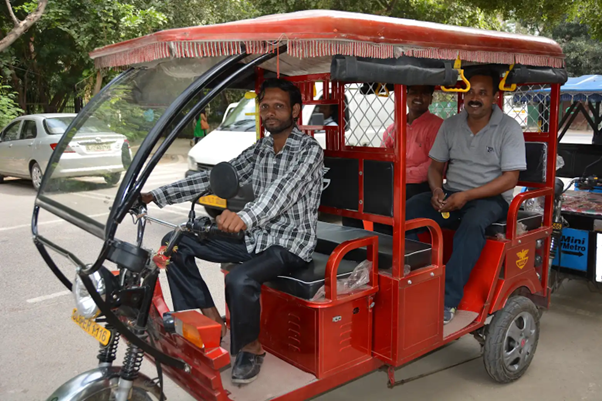 Fig 1: E-rickshaws are becoming the environmentally-friendly transport option of choice in many of India's crowded cities. (Photo by Kiran Sharma)
Summarizing Trends: Heavy Electric Trucks and E-Two and Three Wheelers in India
The Outlook pointed out that India remained the third-largest electric bus market for the second year in a row, as electric bus sales surpassed 4 000 for the first time in 2025. “This increase was supported by the government’s large-scale procurement programmes, including the PM E-DRIVE scheme, which aims to deploy up to 14 000 electric buses nationwide between 2024 and 2026, and the PM-eBus SEWA, which supports the deployment of more than 38 000 electric buses through a payment security mechanism offered to operators,” it said.
Elaborating about the battery electric models, IEA said the market with most of such models available is China – around 450 (half of which are buses. Chinese automakers are also expanding battery electric HDV model availability in emerging markets and developing economies (EMDEs), particularly for buses, it said.
“Available models from OEMs based in EMDEs have also increased steadily over the years, reaching more than 25 in 2025, with India’s automakers offering the largest number of models.The number of OEMs making electric HDVs headquartered in EMDEs including India and countries in South America and Africa has grown steadily, expanding the number of models available,” the Outlook found.
It, however, pointed out that electric truck sales dropped in 2025 in the rest of the world, falling by 15% to 1 900 and reversing several years of growth.” The drop in sales at the global level was despite India’s electric truck registrations increasing from 200 in 2024 to around 800 units,” it said.
One of the many challenges to the transition towards e-mobility is the payload limitations in heavy vehicles. The IEA said policy measures could help address this limitation that results from the electric trucks' large batteries. “In some cases, this limitation may require additional vehicle movements, hence increasing the costs, particularly for low-volume and high-weight freight. It has been estimated that by relaxing weight limits by 2 tonnes, battery electric trucks in India may reach TCO parity with diesel alternatives 2 to 3 years sooner,” it said.
On the other hand, sales of electric 2/3Ws increased almost 15% to reach 11 million globally in 2025, representing around 15% of total 2/3W sales. “The modest rise in sales share (1 percentage point higher than in 2024) reflects diverging trends in major markets,” it said.
“Despite sales in China recovering only to levels similar to those observed in 2023, and sales in India increasing less than in 2024, robust momentum in Viet Nam and Türkiye underpinned global growth. China, Türkiye, India and Viet Nam together accounted for 95% of electric 2/3W sales worldwide. The number of electric 2Ws sold is almost eight times as big as that of electric 3Ws, but the sales share of electric 3Ws reached more than 25%, almost double that of electric 2Ws.” it added.
The Outlook pointed out that India remains the second-largest electric 2W market, despite sluggish sales in 2025. “Sales of electric 2Ws grew by 5% to reach less than 1.3 million, representing around 6% of total 2W sales in the country,” it said.
“Several factors may have contributed to the slowdown in growth compared to previous years. Policy support in the form of the PM Electric Drive Revolution in Innovative Vehicle Enhancement (PM E-DRIVE), introduced in late 2024 and extended to 2028 to replace previously existing financial support schemes, did not provide sufficient impetus for the growth of past years to continue in 2025.
“Under the previous FAME-II scheme, electric 2Ws could receive USD 170/kWh and up to 40% of the vehicle cost. In contrast, under the PM E-DRIVE scheme this was reduced to USD 57/kWh, capped at USD 115 per vehicle for fiscal year 2024-2025 and to less than USD 30/kWh capped at USD 57 per vehicle for fiscal year 2025-2026. Moreover, the new scheme introduced local content requirements that are costly for some OEMs to meet, which in turn has reduced the number of models eligible for subsidies compared with previous schemes,” it said.
“In addition, the September 2025 reform of the Goods and Services Tax (GST) reduced the tax rate for low-displacement ICE 2W models, while leaving the rate for electric models unchanged, weakening their purchase price competitiveness,” the report added.
In India, momentum in electric 3W sales continued to build, with sales rising by 15% from 2024 to almost 800 000 vehicles. “Electric 3Ws now capture almost 70% of all sales in the country, primarily displacing compressed natural gas models. Despite subsidies for 3Ws having been reduced under the PM E-DRIVE policy compared with the FAME II scheme, adoption has not slowed,” it said.
About the Author


