
State governments are moving beyond just policies and are building electric freight corridors to accelerate the shift to zero-emission vehicles
India’s electric mobility transition is increasingly shaped by not just national policy but by sub-national governments taking the lead in turning EV ambitions into real world projects on the ground. Not only have they notified their EV policies, states are moving beyond purchase incentives towards charging infrastructure, fleet electrification, and manufacturing and corridor level planning.
The next frontier is heavy duty transport, where electrification has traditionally faced challenges around vehicle costs, range and charging. Some states like Maharashtra have already started strengthening their policy support specifically for electric trucks, signalling a shift towards treating freight electrification as an infrastructure and economic development priority.
The transition of this segment is particularly crucial since it contributes significantly to emissions, especially the diesel-run trucks responsible for moving around 70% of India’s 4.6 billion tonnes of goods moved annually.
This is also creating momentum towards electric highways that essentially mean corridors where charging, grid capacity, fleet operations and roadside services are planned together. Pilot routes have already been used to test electric freight and passenger operations, providing real-world data on the infrastructure and commercial requirements for longer-distance electrification.
The emphasis is gradually moving from isolated pilots to state-supported projects that can demonstrate how electric trucks can operate at scale. This matters because freight operators need predictable charging, high utilisation and reliable turnaround times and not mere more charging points. The emerging state level approach could therefore become critical to India's highway vehicle transition.
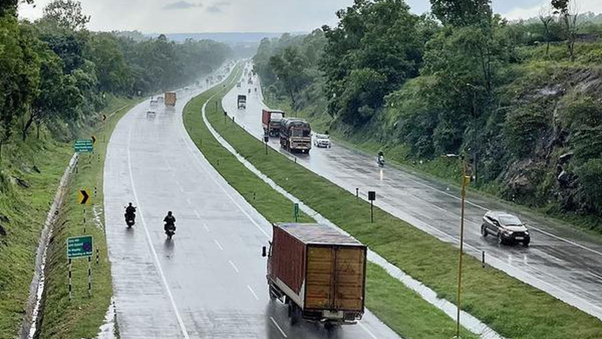 Fig 1: Trucks plying on a highway. File Photo Credit: The Hindu
One such ambitious project has been set out by Kerala , which aims to build India’s first state-led electric truck corridor along national highway 66. The corridor is likely to be over 600 kilometres long, running along the western coast of India and envisages linking ports, industrial clusters and urban centres. The International Council for Clean Transportation (ICCT) analysed the proposed corridor and came up with a report that estimated the charging needs required for the corridor through 2050. Let us take a look at some of the key findings of the report.
The ICCT predicted that the charging demand on NH 66 will scale up to more than 26 times the 2030 level by 2050. It pointed out that the daily grid energy demand is “estimated to reach 32 MWh in 2030, 326 MWh in 2040, and 833 MWh in 2050” owing to increasing BET penetration across all truck segments. “Despite this trajectory, NH-66 truck charging represents less than 0.2% of Keralam’s projected annual electricity consumption through 2040, indicating that aggregate grid stress at the state level will remain manageable,” it said.
The report also projected that the NH 66 will require around 1,939 chargers with a total installed charger capacity of 204.5 MW by 2050. “The Thiruvangad-Kumbalam section—the longest section, at 265 km, and the one that carries the highest truck volumes—is expected to account for the largest share of daily energy demand and installed charger capacity across all milestone years, with a required capacity of 76.4 MW by 2050,” it said.
“The Thalappady-Thiruvangad section follows at 70.7 MW, and Kumbalam-Thiruvallam, although the shortest section, will require an estimated 57.4 MW owing to dense freight activity around Kochi and the emerging port at Vizhinjam. This uneven distribution means that effective buildout of charging infrastructure will likely require that deployment timelines and grid upgrade priorities be differentiated by section rather than treated uniformly across the corridor,” it added.
It also added that the cumulative investment in charging equipment is projected to reach ₹338 crore by 2050. Therefore, these figures offer a clear sense of the scale of the transition required, but they are ambitious yet achievable with sustained policy support, investment and coordinated action.
About the Author


