
Development of cutting-edge technologies to charge EVs are in various stages of development across the world which can fasten the transition to e-mobility
India recently announced plans to strengthen its Electric Vehicle charging ecosystem and scale up the e-mobility landscape in the country. Going by the uptake in EV adoption, around 106 million EVs are expected to be sold every year by 2030 in India. To achieve a ratio of 1:40 charging infra to EVs, India will need to install more than 400,000 chargers annually with a total of 1.32 million chargers till 2030.
To make EVs the mainstream transport across all segments, certain challenges still persist, that include range anxiety, vehicle charging speed and time, availability of reliable and accessible charging infrastructure, and the upfront cost.
However, with technological advancements and persistent research, the EV industry has already introduced cutting-edge solutions, many of which are still in the development stage, that may boost the confidence of consumers for EVs and help fasten this transition. We take a look at some of the upcoming EV charging technologies. .
Catenary EV Charging
Popularly called overhead electric charging, this technology enables the vehicle to charge continuously while in motion. It uses overhead cables to supply power to vehicles through various mechanisms, including a ‘pantograph and energy supply system’. The latter uses the same technology used in railroad electrification, utilising a two-pole centenary system to send continuous power supply for the electrified highway.
The pantograph technology transfers energy from overhead lines to the electric motor of the electric highway. This can be attached from the wire and takes place automatically or through a button. When an EV equipped with this technology enters a road or a highway with overhead wires, the pantograph connects to it, helping the vehicle draw power and charge its battery.
The catenary charging technology has several advantages, one of which is continuous charging for the vehicle which can diminish range anxiety of consumers. Since this technology provides consistent power, the battery size of the vehicle can be reduced, thus helping to reduce the weight and cost of the vehicle. These vehicles are particularly good for fleets which can operate continuously without worrying about charging.
However, this technology too has its share of challenges, one of which is the high installation cost of its infrastructure. It can also limit the flexibility of the vehicle since only those that have this technology can use the infrastructure.
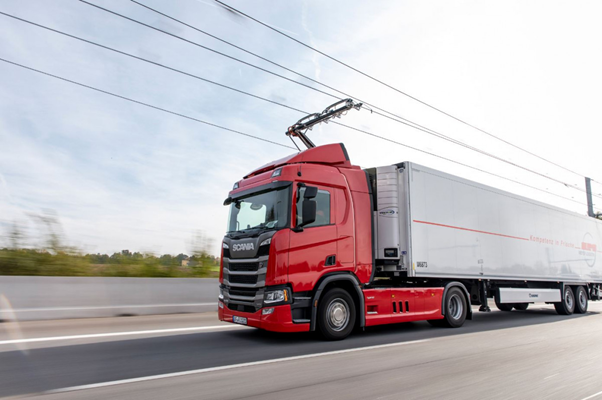 Fig 1: An Electric truck connected to overhead power lines. Image by Siemens
There are other technology solutions which are on the horizon, one of which is the conductive charging, which works both for heavy-duty vehicles and private cars as long as there is a conduction system, such as a rail. The vehicles are charged through a stick that touches the rail.
Dynamic Electric Vehicle Wireless Charging
Also known as the Dynamic Electric Vehicle Charging (DEVO), this enables EVs to charge wirelessly even when they are in motion. This also allows continuous charging in contrast to traditional technologies where the vehicle has to be static while doing so, according to the India EV Digest 2023 released recently. So let's look at some of the aspects of this technology.
Inductive Power Transfer: This technology transfers electricity without wires between coils in the charging infrastructure embedded in the roads and receiving unit that is put under the vehicle, allowing uninterrupted charging to the vehicle.
Embedded Charging Infrastructure: Under this, a charging infrastructure that includes a electricity transmitting coil, is installed in the lane that generates an electromagnetic field. EVs that are equipped with receiving units can convert this energy into electricity to charge their batteries. Advanced alignment and positioning solutions like GPS and sensors are essential to ensure effective and uninterrupted electricity.
These technologies can be used for various EV segments like cars, trucks and buses and deployed in high traffic areas. However, high installation cost of the infrastructure, standardisation, weather conditions and adding interoperability and compatibility with different types of vehicles, remain challenges to adopting this technology.
 Fig 2: Tests with an electric Fiat New 500 have confirmed that in-road inductive charging can deliver theoretically unlimited EV driving range. Image by Stellantis
Nations that are at the Forefront Of Adopting Upcoming EV Charging Technologies
The global electrified roads market is surging, with an overall revenue growth expectation of hundreds of millions of dollars during the forecast period from 2023 to 2032. Europe is expected to retain its spot as the second-largest marketplace in the electrified roads industry, second only to China—the largest contributor to the market.
Germany has already introduced the first electric highway on its motorway system to recharge hybrid trucks as they drive. The e-highway was built by German engineering company Siemens, with assistance by groups from the Technical University of Darmstadt and ENTEGA. Through this, hybrid trucks will connect to overhead cables and charge trucks while they travel at speeds of up to 56mph.
Sweden is now turning a highway into a permanent electrified road - the first of its kind in the world. The country aims to cover approximately 3,000 kilometres of highways with moving charging infrastructure. A study done by the French Transportation Ministry suggested that electrified roads or electric road systems can reduce carbon emissions from road and freight transport by 86%. The same study stated a plan to cover 9,000 kilometres of French roads with electric road systems by 2035.
In the US, Michigan Department for Transportation in 2022 awarded Electreon to build the first public wireless in-road charging system. The department aims to offer $1.9 million as funding for the project which will be operational in 2023. Last year, Washington introduced Wireless Electric Vehicle Grant Program ACT 2023 to boost the deployment of wireless charging systems on state-level for electric vehicles.
Solar EV Charging for Remote Locations
This technology allows charging of the electric vehicle through renewable energy in places where grid connections are not available. It also provides a cost effective solution for both the charge point operator and the consumer. The energy thus generated can be stored in batteries, while smart charging algorithms and load balancing can be used to distribute power evenly to EVs.
Remote monitoring systems can also be put in place to gauge the power generation, storage levels and charging of EVs. This technology is not only crucial to cut the dependence of electricity through conventional power sources but also can be installed in urban areas to overcome the electricity shortage in cities.
Future Battery Technologies
- Graphite-based batteries: Scientists are researching the use of graphite to improve its performance that include higher energy density, faster charging and improved lifespan.
- Sodium -ion batteries: These offer alternatives to lithium-ion batteries by replacing them with ions of sodium which are more abundant and less expensive, making them more cost effective. However, their lower energy density and limited life cycle remain a challenge.
- Hybrid Battery Systems: The technologies of the future may involve hybrid systems that will combine various battery chemistries or integrate batteries with other energy storage technologies like ultra-capacitors to improve power delivery and energy storage.
About the Author


