
The shift towards electric mobility could help India reduce its vulnerability to global oil price and supply disruptions, reduce import bills and drive industrial growth
India’s electric mobility transition is increasingly becoming a story about energy security, industrial competitiveness and economic resilience, along with its climate commitments. The country imports a large share of its crude oil it consumes, leaving its transport economy closely linked to global oil prices and stability of international shipping routes. As conflicts and disruptions increasingly affect strategic maritime passages, reducing dependence on imported petroleum is becoming an important long-term economic strategy.
India has recognized this opportunity relatively early and has spent the past decade building the foundations for a large-scale transformation to electric transport. From electric two and three wheelers to buses, passenger vehicles and commercial fleets, the government has increasingly sought to create demand while building infrastructure and manufacturing ecosystem to support it. This has helped move electric mobility from a niche market towards a mainstream component of India’s transportation strategy.
Much has been achieved but the road ahead is filled with challenges. The focus now is to reduce vulnerabilities in the supply of critical minerals and components while encouraging domestic manufacturing across batteries, cells, and other key components, to help ratchet up the adoption in India. The industrial opportunities are also significant. A larger domestic EV market creates demand not only for vehicles but an entirely new manufacturing ecosystem; battery cells and battery management systems, motors, power electrics, charging equipment and recycling.
A new study takes this argument further. It presents an evidence-based case for India’s EV transition as an economic and energy-security opportunity, “highlighting how electrification can reduce India’s exposure to oil supply shocks and price volatility, lower the import bill, and create new industrial opportunities.”. Lets find out the key highlights of the study.
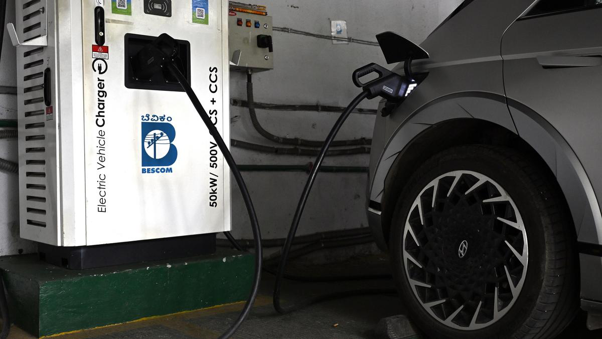 Fig 1: Electric vehicle charging centre at Cubbon Park in Bengaluru on Tuesday 03 September 2024. | Photo Credit: The Hindu
Savings Due To Electrification
It argues that transitioning to electric vehicles could displace between “0.35 million barrels per day (mb/d) in a Business as Usual (BAU) scenario and 0.92 mb/d in a High Growth (HG) scenario by 2030”. The transformation of the transport sector can also lead to significant import reduction. “This displacement is equivalent to offsetting 7% to 19% of India’s current daily crude oil imports,” the study conducted by the Global South Center for Clean Transportation at ITS-UC Davis said.
It asserts that the impact of the EV transition will be cumulative; “by 2030, over 70% of oil displacement will come from the established stock of EVs already on the road.” It pointed out that even if one assumes that 100% batteries are imported, “the transition generates significant net savings. By 2030, India could see net import savings of USD 5.3 billion (BAU) to USD 15 billion (HG).”
“The economics of EVs only improve as global battery prices decline and oil prices rise. In a high oil (USD 100/barrel) and low cell price scenario, net savings could reach USD 26 billion,” it pointed out. India is hugely dependent on import of petroleum, with some estimates pegging it to around 90%. This makes its financial and macro economic stability “vulnerable to structural exposure from OPEC+ decisions and geopolitical shocks, such as the 2026 Hormuz crisis which saw both crude prices surge to USD 112–119 per barrel as well as fuel availability issues.
Therefore, electrification offers a structural pathway to reduce this vulnerability by shifting mobility demand from recurring, imported fuel to domestically produced electricity, the study argued.
The study recommended India to aim for a dual track strategy. As far as immediate gains were concerned, the study said currently, “two wheelers are the primary driver of petrol displacement, contributing 71% of total oil displacement under BAU by 2030 due to their sheer volume in the Indian vehicle fleet.
For longer term gains, it said in early stages, the electrification of medium and heavy duty trucks (MHDVs) offers the greatest opportunity for long term fuel dependency reduction. “In a High Growth scenario, trucks could account for 34% of total oil displacement by 2030.
About the Author


