
The government’s recent initiative to phase out old trucks marks a significant steps towards mitigating climate impacts and urban air pollution
India’s economy moves on the back of its huge commercial vehicle fleet. Millions of trucks transport goods across the country everyday, making road transport the backbone of domestic logistics. India has an estimated 5 million trucks in operation. An overwhelming majority of these vehicles, however, run on diesel, a fuel that contributes significantly to urban air pollution, greenhouse gas emissions and makes the country dependent on crude oil imports.
Therefore, decarbonising the heavy vehicle sector is critical in achieving both national and global climate objectives. As India experiences more frequent and intense heatwaves, driven in part by climate change, reducing emissions from the transport sector has become increasingly important. Transitioning to cleaner technologies, including zero emission trucks, will not only help mitigate climate impacts but also support the country’s commitment to achieve net-zero by 2070.
India has been moving fast towards sustainable transportation and has been handholding the industry by introducing various schemes to enable the transition of these vehicles towards clean solutions. Recognising the need to modernise the heavy vehicle segment to improve air quality, India recently announced a new incentive scheme to phase out older Bharat Stage (BS) Stage IV trucks and replace them with BS VI and electric vehicles in the Delhi-NCR region.
The initiative marks a significant step towards decarbonising the country’s road transport sector. As the most rigorous government-mandated standard for vehicular emissions and the counterpart to Euro 6 norms, BS-VI aims to lower atmospheric pollutants.
According to reports, the scheme will offer a 5% interest subvention on loans for five years and monthly fuel vouchers of up to ₹4,800 for vehicle owners. At the same time, manufacturers will provide an 8% discount on the ex-showroom price of new vehicles purchased under the scheme. “To avail of the benefits, owners will have to scrap BS-III and older vehicles at authorised scrapping facilities,” the reports mentioned.
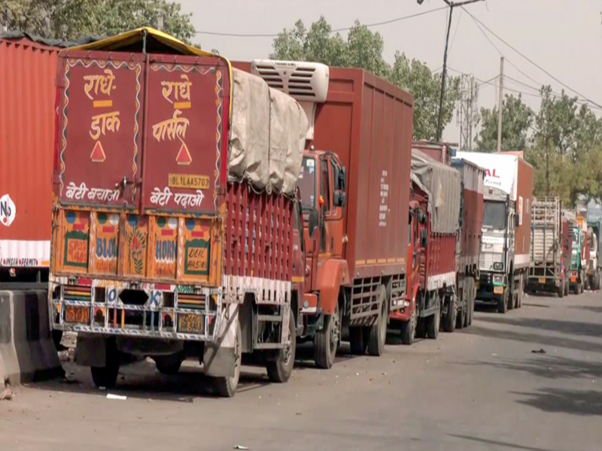 Fig 1: Trucks lined up on a street. File Photo/ANI
Funding for this initiative will be provided by the housing and urban affairs ministry's NCR Planning Board, with implementation led by the ministries of petroleum and natural gas, as well as road transport and highways. While BS-IV vehicles remain eligible for sale and use in locations outside the National Clean Air Programme, this specific scheme focuses on modernizing the fleet within designated regions.
The scheme will be implemented in collaboration with the participating states and Union Territories of Delhi, Haryana, Rajasthan, and Uttar Pradesh. The scheme is expected to benefit approximately 2.07 lakh (1.91 lakh trucks and 16,329 buses) owners in Delhi-NCR (comprising Delhi, Haryana, Rajasthan, and Uttar Pradesh).
“State governments will waive registration fees and grant up to 100% motor vehicle tax concessions for new vehicles and 50% for used vehicles for 10 years. State Government will also waive off pending liabilities on the old vehicles participating in the scheme,” one of the reports said.
“Implementation will be fully digital through an integrated portal, which will enable real‑time eligibility checks, automated interest subvention claims, monthly fuel voucher credits, and monitoring of pollution reduction outcomes. The benefits by the central government will continue for 5 years from the date of registration of the new vehicle, ensuring sustained impact beyond the two‑year enrolment window,’ it added.
The air pollution crisis in Delhi-NCR persists far past the winter season. While seasonal elements like stubble burning and unfavorable weather patterns intensify pollution during October and November, air quality stays at poor levels throughout the year. This ongoing issue is driven by various sources, including vehicle emissions, industrial output, construction projects, road dust, and the burning of waste.
About the Author


